

For lots stuck on rankings
Local rankings need more than a homepage blog
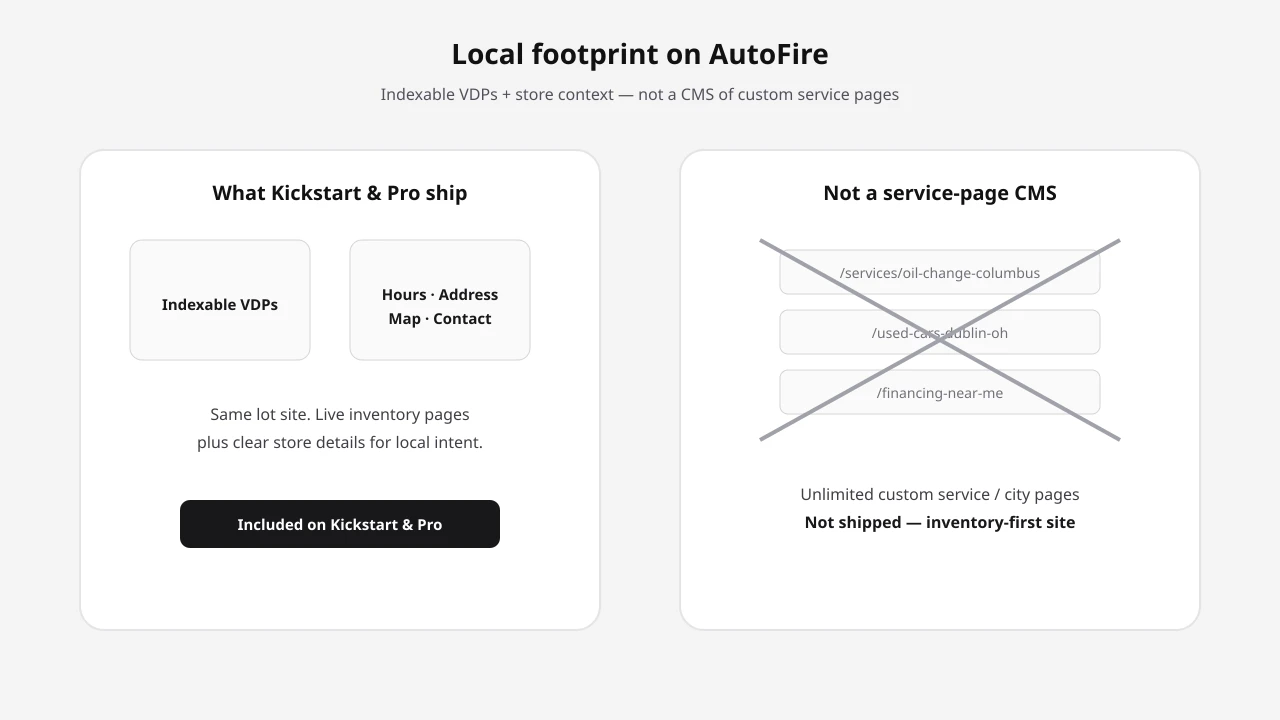
Agencies often sell “service and location pages” as retainer work. Independent lots hear that pitch and expect a stack of city or service URLs. AutoFire covers that local footprint with indexable vehicle detail pages plus dealership location and contact context on the lot site (Kickstart and Pro)—hours, address, map, and contact alongside live inventory. It is not a page-builder for unlimited custom service pages.
Switching platforms does not magically fix SEO. What matters is crawlable VDPs and clear store context for local intent—without paying a retainer just to stand that foundation up.
Why dealership SEO feels expensive (and thin)
Most independent lots are not missing a blog calendar. They are missing live, indexable pages for each car, tied to a store Google can place on the map. Agencies package that baseline as project work. WordPress DIY turns into hand-edited titles every time a VIN turns. Buyers still search make, model, and local intent—and a homepage that never changes cannot answer those queries.
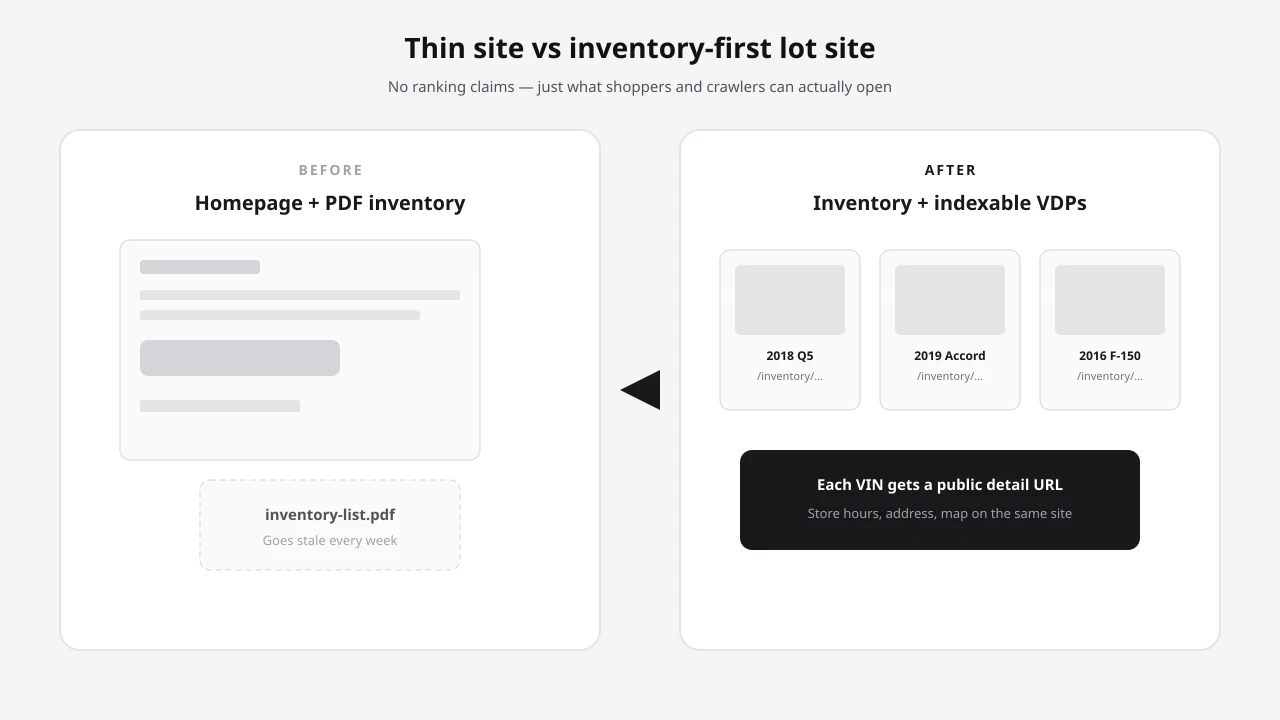
Picture a 40-unit independent lot outside Columbus. The site is a thin homepage, a phone number, and a PDF inventory list that goes stale every week. Shoppers searching make/model and “near me” never land on a page that matches one car plus the store. The owner gets pitched monthly retainers for the service and location footprint agencies sell as packages. With AutoFire they add units in Dashboard → Inventory; each VIN gets a public VDP with photos, price, and specs, while the lot’s address, hours, and map stay on the same site. That is the local footprint—inventory pages and store context—not a binder of hand-built city pages.
Industry research points the same direction. In the Cox Automotive 2025 Car Buyer Journey Study, 59% of recent buyers used a dealership website while shopping (60% among used buyers), and 41% used search engines, while third-party sites still led at 75%. Think with Google reported that search interest for “car dealerships near me” doubled year over year in their measured period, and interest in whether the right car is in stock grew more than four times faster than overall auto search. Those are published industry figures, not AutoFire customer results.
How AutoFire covers the local inventory footprint
Dealership SEO for a used lot is mostly an inventory problem wearing marketing clothes. When a car hits the lot Monday and sells Friday, the public page has to appear and disappear with it. AutoFire treats SEO as part of that workflow: publish from inventory, get a vehicle detail page with schema-oriented markup and brand metadata, keep hours and location on the same site, and optionally push the same stock out on Pro feeds without rebuilding on-page work per channel.
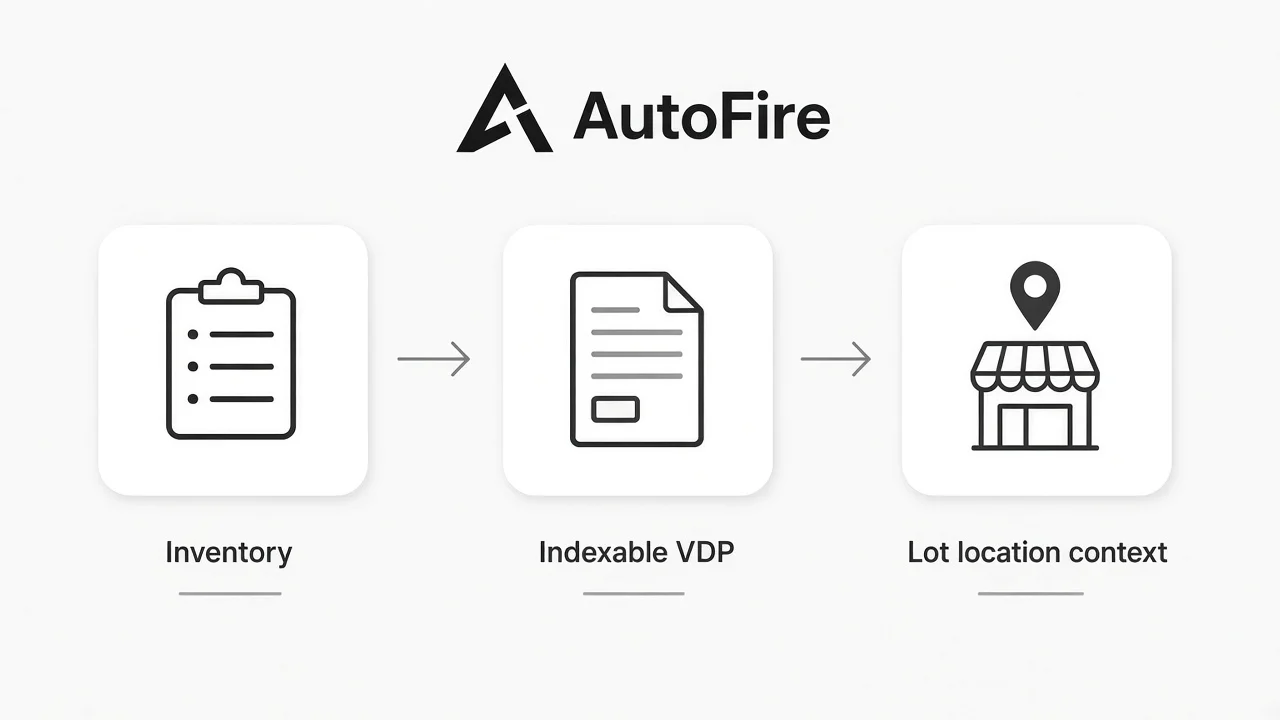
Inventory → automatic vehicle detail pages
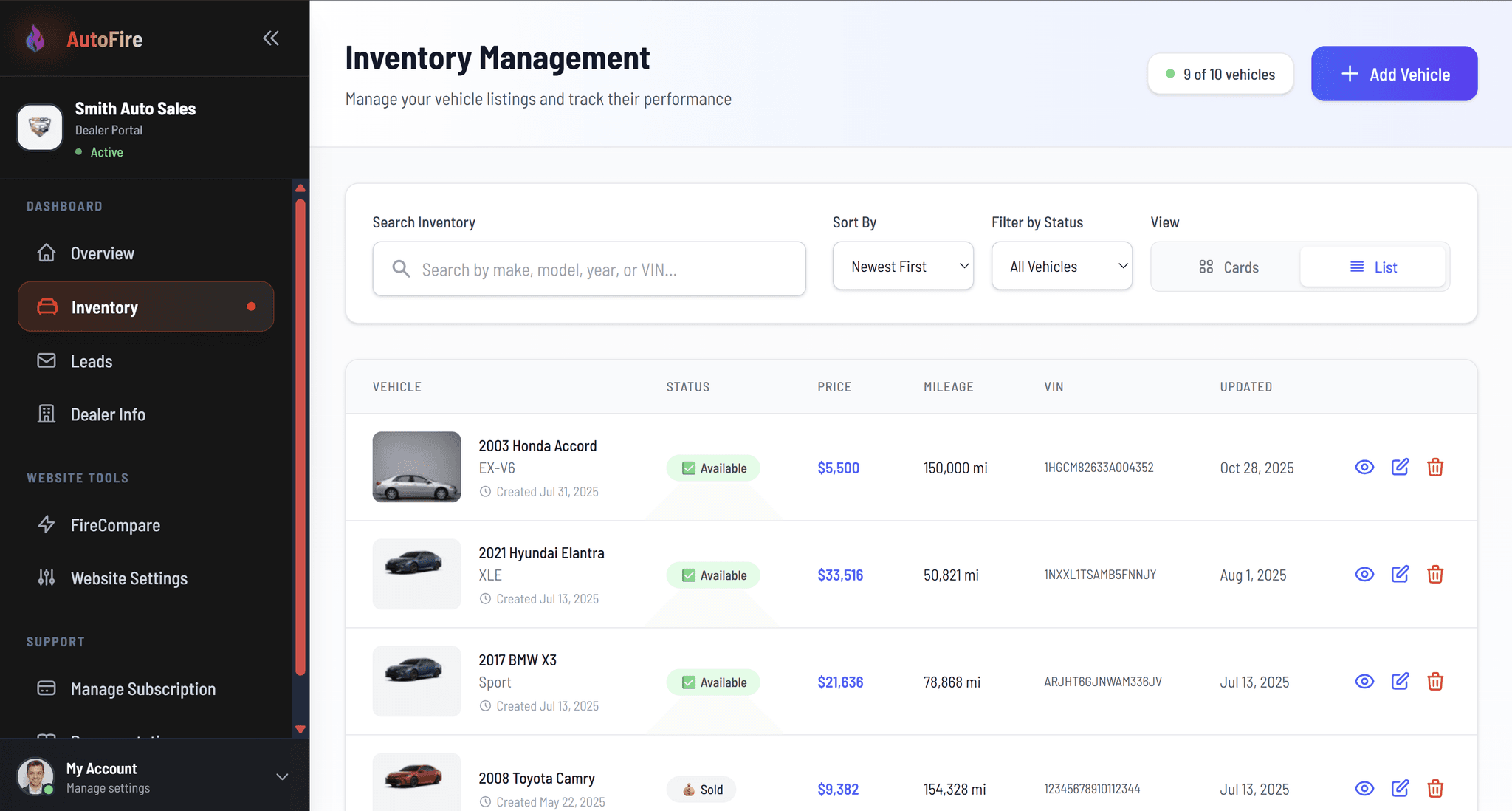
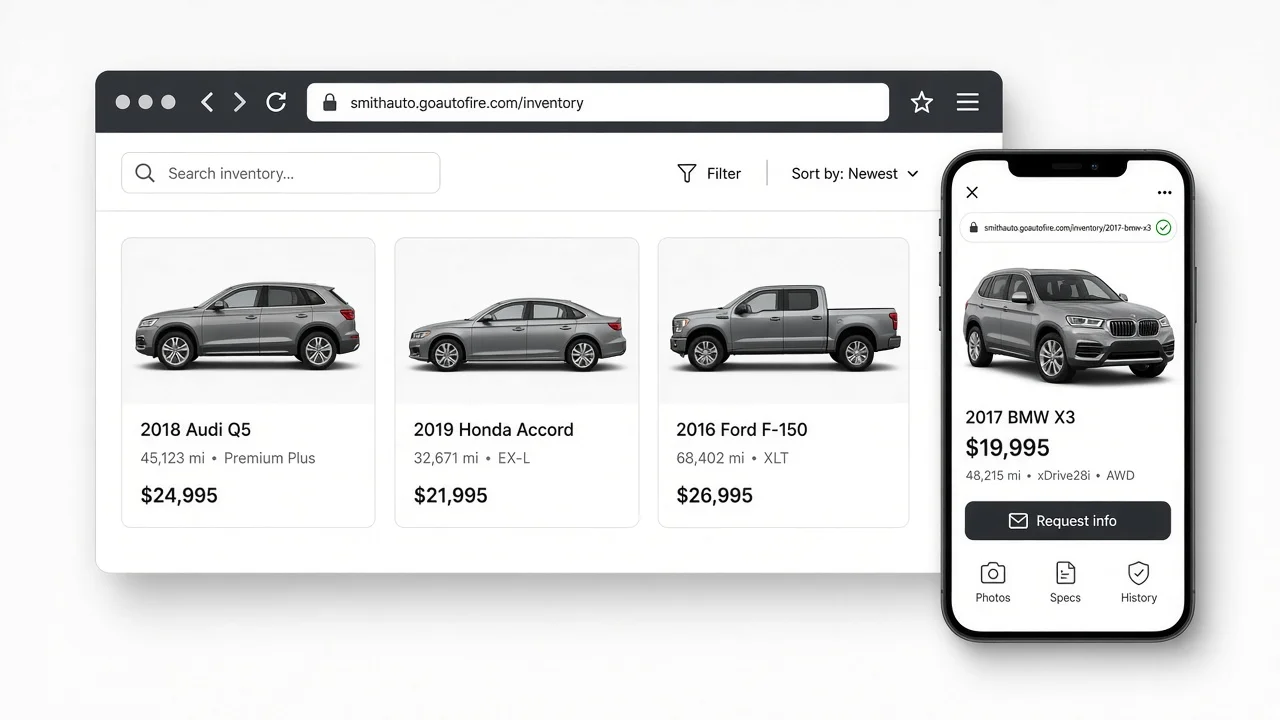
Add a car in Dashboard → Inventory with photos, price, mileage, and specs. AutoFire publishes a public vehicle detail page with its own URL. When the unit sells or the price changes, the page follows the listing. You are not maintaining a parallel SEO spreadsheet for every VIN that turns that week.
Dealership location and contact on the same site
Hours, address, map, and contact paths sit on the lot-site template next to inventory. Kickstart and Pro both include that store context. Local “near me” intent needs somewhere to land besides a Facebook page. This is store detail on the dealer site, not a stack of hand-built city landing pages.
Structured data from live listing fields
Schema-oriented markup and vehicle facts are generated from the same fields shoppers see. Update make, model, year, or price in inventory and the public page stays aligned. See Features → SEO for how markup and metadata ship with each VDP.
Brand metadata that matches the dealership
Titles, descriptions, and share previews stay tied to dealership settings and live stock instead of a forgotten theme default. When someone shares a vehicle link, the preview should look like your store, not a blank template.
Mobile-ready lot sites
Most car shopping starts on phones. AutoFire dealer sites are responsive so inventory grids and vehicle detail pages stay usable on the lot driveway or a lunch break scroll. Speed and layout are part of the same product surface as the pages themselves.
Optional syndication on Pro
Pro Distribution can push the same inventory to Google, Meta, and marketplace feed workflows without rebuilding on-page SEO per channel. Feeds complement the VDPs on your site. They do not replace them. Kickstart keeps the site and inventory pages online if you are not ready for Pro tools yet.
Deep dive: Features → SEO · Inventory · Inventory syndication
Agency retainer versus AutoFire on the lot site
An SEO agency can still be the right hire when you want link outreach, content programs, or paid search management. AutoFire will not do those jobs. We do not run Google Ads. We do not sell monthly link campaigns. What we include is the website and inventory stack many retainers quietly assume you already have: per-VIN pages, structured data from live stock, and store location details on the public site.
If you already work with an agency, point them at your AutoFire domain as the owned destination. If you do not want a retainer just to get usable vehicle pages online, start with Kickstart or Pro and publish inventory the same day.
What is included versus what agencies often sell
| Feature | AutoFire | Typical SEO agency |
|---|---|---|
| Indexable vehicle detail pages (per VIN) | Often scoped as project work | |
| Structured data from live inventory | Usually billed separately | |
| Dealership location & contact on the lot site | Included with Kickstart & Pro | Often sold as location-page work |
| Unlimited custom service pages CMS | Not shipped — inventory-first site | Common page-builder deliverable |
| Monthly SEO retainer required | ||
| Link building / outreach campaigns | Not included — we do not run these | Often sold as add-ons |
| Google Ads management | Not included — we do not run ads | Often sold as add-ons |
What AutoFire does
- Indexable VDPs from live inventory (Kickstart and Pro)
- Schema-oriented markup and brand metadata on those pages
- Dealership hours, address, map, and contact on the lot site
- Optional Pro feeds that reuse the same stock
What AutoFire does not do
- Guarantee rankings
- Run link building or Google Ads
- Ship an unlimited custom service/city page CMS
- Pretend switching platforms alone fixes SEO
Who this dealership SEO approach fits
AutoFire fits independent used lots and small multi-car operations that want a same-day site with inventory search engines can read. You care more about each VIN having a real page than about a drag-and-drop builder for twenty static service articles. You may already try Facebook Marketplace or Craigslist and still want a branded home base for Google traffic and phone referrals.
Day one looks ordinary on purpose. Create the account, set dealership details, upload a few vehicles, and the public site shows stock with detail URLs. Custom domains, feeds, and other Pro tools wait until you need them. Free Kickstart exists so a small lot can stay online after a trial without pretending enterprise SEO work was bundled for free.
It is a weaker fit if your primary need is unlimited custom landing pages, franchise OEM modules, or a full-service SEO agency bundled into the website fee. Those are different products. Our comparisons and SEO feature page describe what ships today without invented ROI stories.
For local strategy reading beyond the product, see local SEO for car dealerships and car dealership marketing strategies. When you want to click through a live storefront, open the demo. Plan limits live on pricing.
Frequently asked questions
Does AutoFire guarantee rankings?
No. Honest platforms do not. AutoFire gives you indexable vehicle pages, structured data, brand metadata, and mobile-ready layouts so search engines can understand your lot and each car. Competition, demand, and consistency over time still decide where you show up.
How is this different from hiring an SEO agency?
Agencies sell retainers for audits, content, outreach, and campaigns. AutoFire is the dealership website and inventory system with technical SEO fundamentals built in. We do not run link campaigns or Google Ads. You can still hire an agency for that work and point it at your AutoFire site.
Is dealership SEO just writing blog posts?
Blogs can help, but shoppers searching make, model, and near me need live vehicle pages and clear store details. AutoFire focuses on inventory-driven VDPs and dealership location context first.
Who is this for?
Independent used car dealers and small lots that want organic visibility without an enterprise CMS or a monthly SEO retainer just to get usable vehicle pages online. Managed link building and paid search stay outside AutoFire.
What about the service and location pages agencies pitch?
Agencies often sell a service and location footprint as retainer work. AutoFire covers that local need with indexable VDPs plus dealership location and contact context on the lot site (Kickstart and Pro)—not a CMS of unlimited custom service or city pages.
Explore more
Get SEO-ready vehicle pages without an agency retainer
Start free on Kickstart or go Pro. Publish inventory, get indexable VDPs, and put your store’s location context on the same lot site—then book a demo if you want a walkthrough. Local footprint = VDPs + store details, not a platform switch that magically fixes SEO.