
Free vs paid plans: what changes on your public site?
The Free plan and every paid plan publish a public lot site with inventory pages and store details. Paid plans add distribution and growth tools on top of the same inventory-first model. Upgrading does not make AutoFire an SEO agency, and it does not unlock unlimited city or service landing pages. Choose based on listing headroom, feeds, and chat needs, not ranking promises.
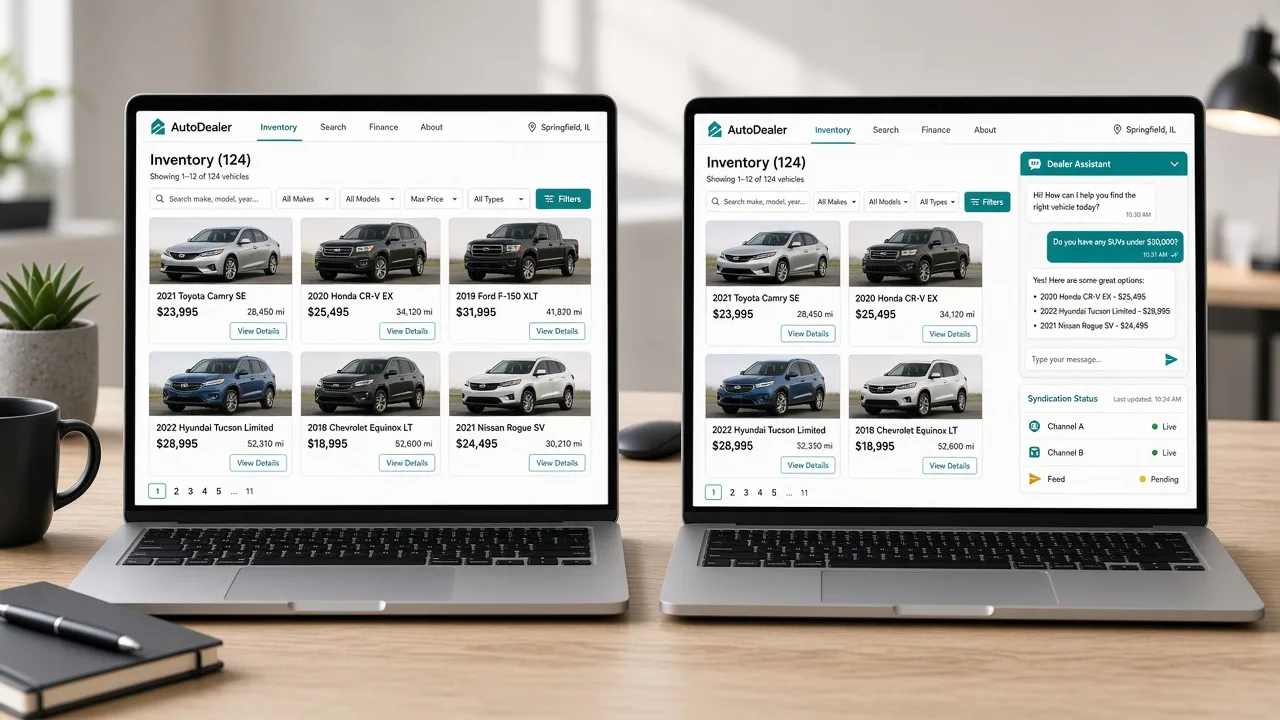
What every plan publishes on the public site
The Free plan and every paid plan give you a public dealer site built around inventory. Shoppers browse listings, open vehicle detail pages, and find lot hours, address, map, and contact on the same property.
That shared foundation matters. Upgrading is not a promise that rankings suddenly appear. It adds capacity and tools on top of the same crawlable vehicle page model.
Whether you are on Free or a paid plan, a buyer can open your Civic VDP, see photos and price, and confirm how to visit. The public layout does not flip to a brochure-only site when you upgrade.
If you need the VDP definition first, read /learn/dealer-websites/what-is-a-vdp. For the wider site picture, see /learn/dealer-websites/what-is-a-dealership-website.
What paid plans add
The paid tiers are Starter $59.99/mo (25 active vehicles), Pro $99.99/mo (75 active vehicles), Growth $199/mo (200 active vehicles), Ultra (custom terms). Every paid tier includes the same core tools: custom domain, scheduling, Meta and marketplace feeds plus a Google export requiring provider setup, AI inventory chat, LotIQ, and FireCompare. Tiers differ in vehicle capacity and included usage, not in which tools you get.
In plain terms, a paid plan bundles inventory, site, syndication, and chat into one subscription. Free stays the path for tiny lots, up to 10 active vehicles on an AutoFire subdomain, that mainly need the public site online.
On a paid plan, you still edit inventory the same way, then use syndication when you want stock on partner channels, and chat when you want on-site help for shoppers. Free stops short of those growth tools. The public buyer experience stays inventory-first either way: browse cars, open a VDP, find lot contact on the same site.
How syndication relates to your site is spelled out at /learn/dealer-websites/what-is-inventory-syndication.
What does not change when you upgrade
A paid plan does not make AutoFire an SEO agency. We do not sell link-building retainers, managed Google Ads, or ranking guarantees. Soft dealership SEO remains crawlable VDPs plus lot context on the site you publish.
Paid plans also do not unlock a CMS of unlimited custom service or city landing pages. Local footprint stays inventory pages and store details. Overview: /solutions/dealership-seo. Local framing: /learn/dealer-websites/local-seo-for-used-car-lots.
If someone pitches "upgrade for rankings" or "a bigger plan unlocks fifty city pages," that is not how AutoFire works. Paid plans add distribution and growth tooling around the same inventory-first site.
Search-friendly vehicle basics still apply on every plan. Reminder: /learn/dealer-websites/seo-friendly-vehicle-pages.
Distribution and feeds: the main operational gap
Free gets cars and lot contact public. Paid plans are where feed-oriented syndication lives when you want the same stock on Google-oriented paths, Meta, and marketplace partners without retyping every unit.
Feeds extend reach. They do not replace VDPs on your domain. When a channel glitches, your site should still show today's lot. Contrast with marketplace-only strategies at /learn/dealer-websites/dealer-website-vs-marketplace-listing.
Every paid plan includes a Google inventory export for provider mapping and validation. Paid Vehicle Ads require separate Google account setup, approval, and ad spend. Read /learn/dealer-websites/google-vehicle-listings-for-independents before you assume a surface is live.
Marketplace discovery still matters for many independents. How buyers use Cars.com versus your site: /learn/dealer-websites/dealer-websites-vs-cars-com.
How to choose between Free and a paid plan
Stay on Free if your inventory fits within 10 active vehicles and you primarily need crawlable VDPs and store details live. Move to a paid plan when you need feeds, a custom domain, chat, or more listing capacity, then pick the tier that matches how many cars you carry.
New dealerships get a 30-day Pro trial after approval, with no automatic paid conversion. See Pricing for current trial terms. After that, keep Free or subscribe to the paid tier that fits your lot. Either way, the public site stays inventory-first.
Simple rule: if your week is about getting cars online and answering calls from the lot site, Free may be enough. If your week includes pushing stock to marketplaces and feed partners, a paid plan matches that workload.
Cost-sensitive lots comparing the cheapest path to a real site should read /learn/dealer-websites/cheapest-dealer-website-for-independents next.
What shoppers see either way
From the buyer's side, the difference between Free and a paid plan is mostly invisible on the lot site itself. They still open a vehicle page, scroll photos, check price and mileage, and look for hours and a map before they drive over. A paid plan changes what happens behind the scenes: more listing headroom, outbound feeds, and chat when you turn those tools on.
That is why plan choice should follow operations, not vanity metrics. An eight-car lot that answers every lead by phone may never need syndication in year one. A forty-car lot retyping the same Silverado into three portals every Monday feels the upgrade on the first clean feed run.
No plan publishes unlimited service or city landing pages. No plan makes AutoFire your SEO agency. Every plan keeps the public story honest: here are the cars, here is how to visit.
If you are evaluating vendors, ask what happens on the public site after signup, not what ranking slide is in the deck. Inventory pages plus lot contact are the product. Paid plans wrap distribution and chat around that same foundation.
Downgrade paths matter too: if you leave a paid plan, the public site keeps showing cars up to the Free limit. You lose feed and chat tooling, not the inventory-first page model. That continuity is intentional. Plan changes should not force a rebuild of every VDP you already published. Your AutoFire subdomain keeps serving the same inventory-first property.
Ask one more operational question before you upgrade: can someone on the desk clear sold units and answer feed errors the same week? If not, stay on Free until that habit exists. Paid plans amplify clean inventory. They do not invent desk capacity.