 ™
™

So, what exactly is "digital retailing" in the car world?
It’s about taking the most time-consuming parts of buying a car—things like getting a trade-in value, figuring out payments, and applying for financing—and moving them online. You're essentially creating a digital express lane on your website, letting customers do the legwork from their couch, on their own schedule.
This turns your website from a simple classified ad into a place where deals actually start to take shape. It’s not about replacing your physical dealership; it's about making it a 24/7 operation that brings in better, more committed buyers before they even set foot on your lot.
What Is Automotive Digital Retailing?
Think of your website's evolution. A decade ago, it was probably just a digital brochure with some photos and a phone number. Now, it needs to be an interactive showroom where customers can take real, meaningful steps toward a purchase.
This modern approach saves a massive amount of time for everyone involved. The customer feels empowered, and your sales team gets to work with people who are much further down the buying path.
From Static Listings to an Interactive Showroom
A true digital retailing automotive strategy lets a buyer do more than just look. It gives them tools to make decisions.
This means adding key features directly to your vehicle listings:
- Value a Trade-In: Let them enter their vehicle's details and get a real, data-driven offer right then and there.
- Calculate Payments: Give them an interactive calculator to play with down payments, loan terms, and interest rates to find a monthly payment that works for them.
- Apply for Credit: A secure, online credit application lets a serious shopper get pre-qualified, turning an anonymous click into a genuine, finance-ready lead.
When you offer this kind of transparency and control, you build instant trust. And dealers are catching on fast. A study from Cox Automotive found that the number of dealerships offering every single purchase step online doubled in just two years. It's a clear sign that the best operators are boosting their close rates by giving buyers what they want. You can dive into the full study on the digitization of automotive retail at CoxAutoInc.com.
Digital retailing isn't about getting rid of the handshake; it's about making that handshake count. When a customer has already done the heavy lifting online, your in-person meeting is for confirming a great decision, not starting a stressful negotiation.
Ultimately, this all leads to a much smoother close. Your customers walk in the door not as tire-kickers, but as confident buyers ready to sign off on a deal they’ve already built and personalized for themselves.
The Five Pillars of Your Digital Showroom
A solid digital retailing strategy isn’t some single, magical piece of software. It’s actually built on five core pillars that work together to guide a customer from just browsing your site to actually buying a car. Think of them as the essential building blocks for your online showroom.
Each pillar tackles a critical step in the modern car-buying journey, logically moving a shopper from initial curiosity to a done deal. When you put these pieces in place, you give buyers the control and transparency they’ve come to expect, building serious trust before they even think about visiting your lot.
This diagram shows exactly how your dealership uses these digital tools to create a direct, efficient bridge to the modern car buyer.
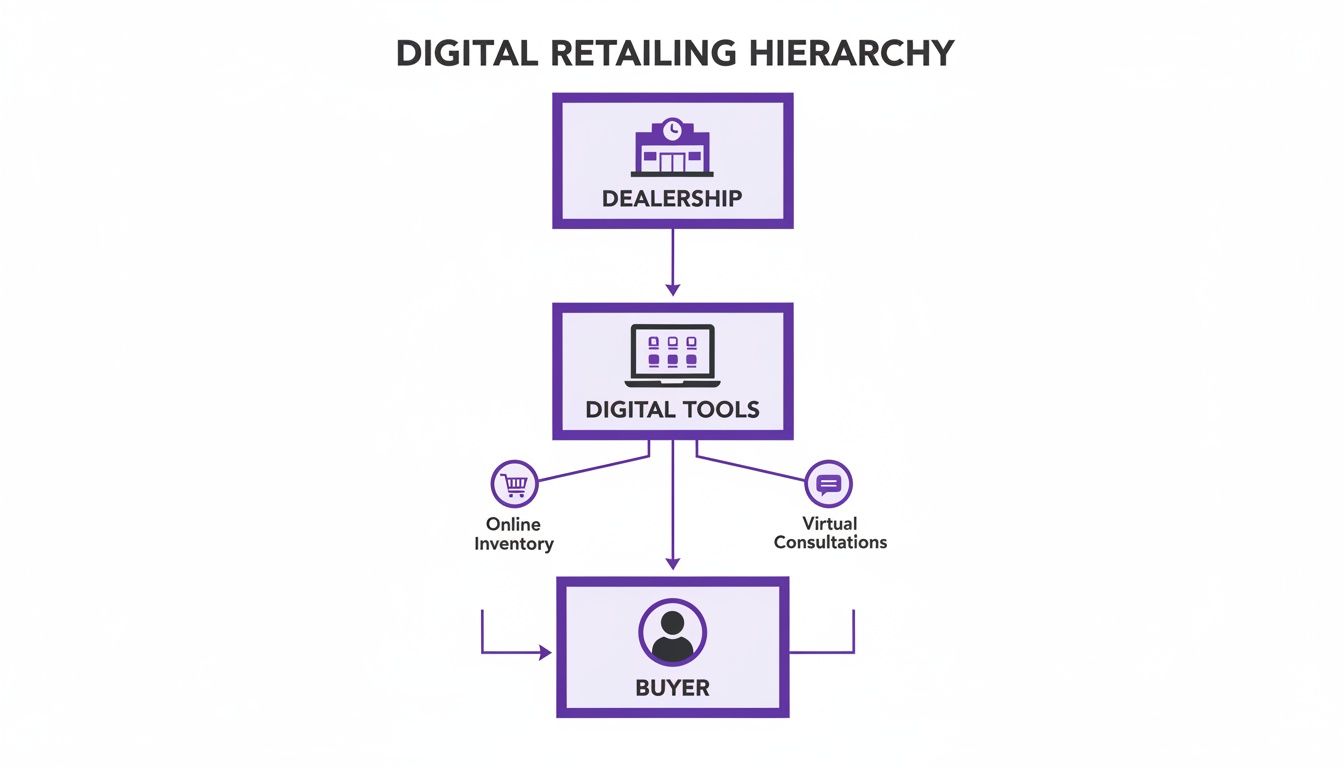
As you can see, it’s a clear flow: your inventory and services pass through a set of digital tools, creating an easy, accessible path for your customers. Let’s break down the pillars that make it all happen.
Pillar 1: Dynamic Vehicle Pages
Your Vehicle Detail Pages (VDPs) have a much bigger job than just showing a few pictures. They need to be a virtual test drive. This means loading them up with high-resolution photo galleries, 360-degree views of the inside and out, and detailed feature lists. The goal is to anticipate and answer every single question a buyer might have about the vehicle’s condition.
To get this right, check out our in-depth guide on effective website design for car dealers.
Pillar 2: Transparent Deal Structuring
Nothing frustrates a car buyer more than fuzzy math and hidden numbers. Transparent deal structuring tools, like an interactive payment calculator, get rid of that friction right away. Research from CarGurus has found that a significant portion of buyers are most annoyed by not getting payment information before they have to talk to someone.
When you let customers play with the numbers—adjusting down payments, loan terms, and interest rates—you empower them to build a deal they're comfortable with. That confidence makes them far more likely to move forward.
Pillar 3: Instant Trade-In Valuations
The trade-in is often the first real financial step a customer takes. Placing an instant, data-backed valuation tool on your website gives them immediate skin in the game. When a customer gets a fair, transparent offer for their current car, they’re way more likely to stick with you for the rest of the process.
This one simple feature can turn an anonymous visitor into a hot lead with a clear path to a purchase.
A successful digital showroom doesn't just list cars for sale; it provides customers with the tools they need to buy a car. Each pillar is a step that removes an obstacle and builds momentum toward the final purchase.
Pillar 4: Online Credit and Payment Tools
Once a customer has a deal structure they like, the next logical step is financing. An integrated, secure online credit application lets serious buyers get pre-qualified without leaving their couch. This is a massive conversion point. It turns a "shopper" into a "finance-ready buyer."
This saves everyone a ton of time at the dealership and gives your team a crystal-clear picture of the customer's buying power before they walk in the door.
Pillar 5: Remote Paperwork and E-Signing
Finally, giving customers the ability to handle paperwork from home is the ultimate convenience. By offering remote document signing and e-contracting, you eliminate the most tedious part of the car-buying experience. This final pillar streamlines the last step, creates a fantastic customer experience, and helps you turn your inventory that much faster.
A truly effective digital retailing platform is built on these five pillars. Below is a simple breakdown of how each component benefits both your customers and your dealership.
Core Components of a Digital Retailing Strategy
| Component | Customer Benefit | Dealership Benefit |
|---|---|---|
| Dynamic VDPs | Provides a complete, immersive view of the vehicle, answering questions upfront. | Builds buyer confidence, increases time on site, and generates higher-quality leads. |
| Transparent Deal Structuring | Empowers buyers to create a personalized deal that fits their budget, reducing anxiety. | Filters for serious buyers and shortens negotiation time on the lot. |
| Instant Trade-In Valuations | Delivers a fast, fair, and trustworthy offer, creating immediate engagement. | Captures high-intent leads early and secures a key part of the deal. |
| Online Credit & Payments | Offers a convenient, secure way to get pre-qualified from anywhere, at any time. | Streamlines the F&I process and identifies finance-ready buyers. |
| Remote Paperwork & E-Signing | Saves time and eliminates the hassle of in-person paperwork, concluding the sale easily. | Accelerates the final sale, reduces contract errors, and improves CSI scores. |
By integrating these features, you're not just selling cars online; you're building a modern, customer-centric experience that drives real results.
Let’s be honest: for an independent dealer, going up against the massive marketing budgets of the big franchise stores can feel like David vs. Goliath. But digital retailing tools are the ultimate slingshot, changing the game from who has the biggest billboard to who delivers the best, most convenient online experience.
Suddenly, your dealership isn't just a physical lot with set hours. It's a 24/7 digital showroom that puts the customer in the driver's seat, letting them value their trade, calculate payments, and get pre-qualified on their own time.
Attract Better, More Serious Buyers
Think about the difference between traditional advertising and a digital retailing approach. Old-school ads cast a wide, often inefficient net, pulling in everyone from serious buyers to Sunday afternoon browsers. A website with real deal-building tools, however, acts as a powerful, self-service filter.
When a shopper takes the time to fill out a trade-in form, play with payment scenarios, and submit a credit application, they're sending a crystal-clear signal. They aren't just "leads"; they're highly motivated buyers who are already emotionally invested in a specific car on your lot. This lets your sales team skip the cold prospecting and jump straight to closing with customers who are ready to go.
Put Your Team's Time to Better Use
How much time does your team spend on repetitive, manual tasks? Answering basic financing questions, keying in customer info, going back and forth on trade values—it all adds up. Digital retailing tools automate a huge chunk of that administrative work.
When the initial steps of the deal happen online, you free up your team to do what they do best: build rapport, show off the cars, and finalize the sale. Let the technology handle the busywork so your people can focus on the human connection.
For a small, lean team, this kind of efficiency isn't just a nice-to-have; it's a game-changer. You can handle more customers and close more deals without running your staff into the ground.
Grow Your Reach and Boost Your Bottom Line
Your physical dealership is limited by geography, but your website has no borders. A powerful digital presence pulls in buyers from the next town over, the next county, and sometimes even the next state. A bigger audience means turning your inventory faster, which is the key to profitability.
The modern car buying journey almost always starts online. Studies show that the vast majority of buyers kick off their research on the web, with a significant portion of that happening on a smartphone. This is precisely where platforms like AutoFire™ shine, by creating clean, mobile-friendly sites that are built to capture and convert. You can find more stats on automotive digital retailing trends on Accio.com.
On top of that, digital retailing makes it easy to introduce Finance & Insurance (F&I) products much earlier. When customers can explore options like an extended warranty or GAP coverage right in the payment calculator, they can make a decision in a low-pressure environment. The result is often higher F&I adoption and more profit on every single vehicle sold.
Your Roadmap to a Digital-First Dealership
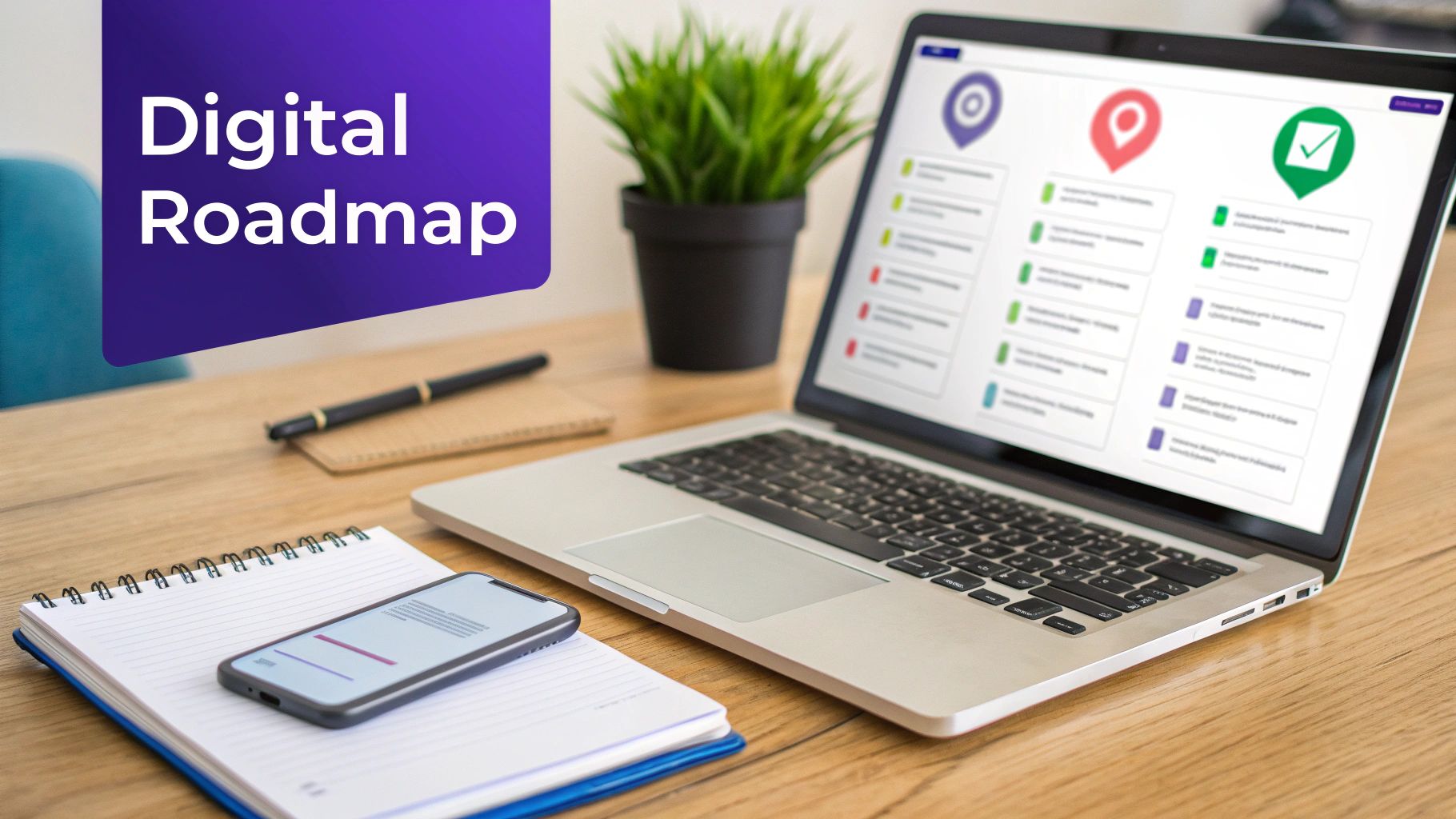
Making the jump to a modern digital retailing automotive strategy can feel like a massive project, but it doesn't have to be. If you break it down into a clear, manageable roadmap, you can make the shift without the usual technical headaches. This step-by-step plan is built specifically for independent dealers, focusing on practical moves that get you results quickly.
Think of it like building a house. You wouldn't start hanging pictures before pouring the foundation, right? Each step here builds on the last, creating a solid structure for your online sales and setting you up for success down the road.
Step 1: Build Your Digital Foundation
Everything starts with your website. It’s no longer just a digital business card—it’s your main showroom, your sales floor, and your F&I office all rolled into one. Before you can bolt on any fancy deal-making tools, you need a high-performance, mobile-friendly website that’s fast, secure, and dead simple for customers to use.
The reality is, most of your customers are shopping on their phones. If your site is slow or a pain to navigate on a small screen, they're gone. They won't be back. Your foundation has to be built with a mobile-first approach, guaranteeing a smooth ride for every visitor, no matter what device they’re on.
A great website is the engine of your digital retailing strategy. It has to be powerful enough to handle inventory feeds, fast enough to keep buyers engaged, and reliable enough to run 24/7 without you constantly having to fix it.
Step 2: Activate Core Sales Tools
Okay, foundation's poured. Now it's time to add the tools that turn casual browsers into serious buyers. This is where you bring the core pieces of digital retailing to life, right on your vehicle detail pages (VDPs). The goal is simple: let customers take real, meaningful steps toward buying a car, all on their own terms.
This means switching on features that automate the tedious stuff and capture leads from people who are genuinely interested. Start with the essentials that give you the most bang for your buck:
- Integrated VIN Decoder: This little tool is a huge time-saver. It automatically fills in all the vehicle features and specs, so you don't have to, and it ensures everything is accurate.
- Instant Trade-In Valuations: Let customers get a real-time estimate for their trade-in. This gives them immediate skin in the game and a clear idea of their buying power.
- Effective Lead Capture Forms: Think of these as your digital hand-raisers. Smart, simple forms make it easy for shoppers to say, "I'm interested, let's talk."
As you map out your dealership's online strategy, it's worth diving into these lead generation best practices, which are absolutely critical for selling cars online today. These tools work in tandem to sift through the tire-kickers and hand your sales team qualified leads who are much further along in the buying process.
Step 3: Connect to Online Marketplaces
The final step is to push your inventory to where the buyers are. Your website is your home base, but you need to get your listings out on the big online marketplaces to cast a wider net. This is how you get your vehicles in front of the largest possible audience.
Connecting your inventory feed to platforms like Google Vehicle Listings is a must. This integration automatically puts your cars right in front of people searching on Google, driving free, high-quality traffic straight to your VDPs. By truly mastering how to sell cars online, you turn your dealership into an always-on sales machine, pulling in customers from well beyond your own zip code.
Optimizing Your Digital Storefront for Customers and Search Engines
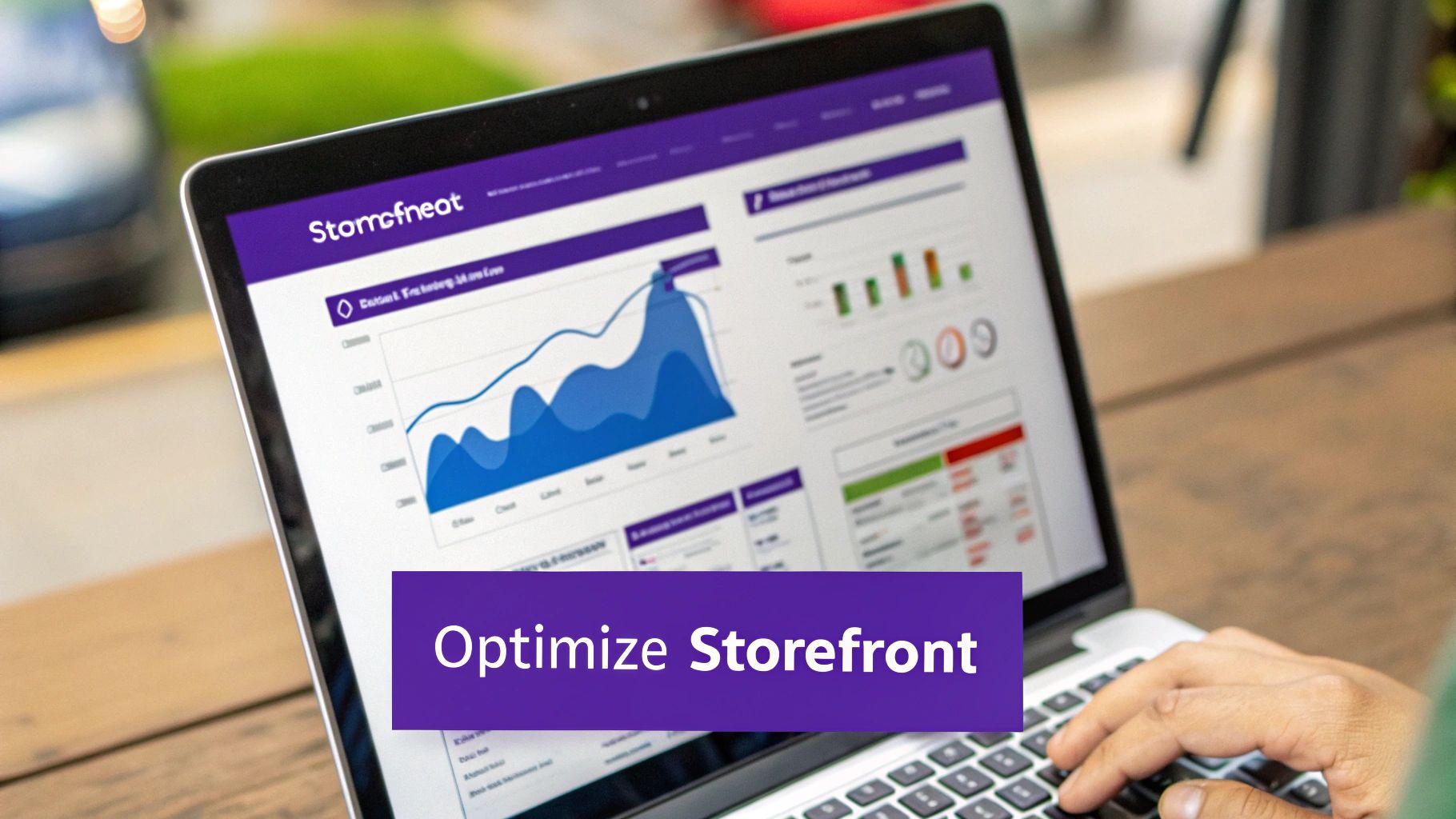
Having the best digital retailing tools is a lot like stocking your lot with incredible cars. It’s a great start, but it doesn't mean much if buyers can't find you or have a terrible experience once they arrive. Your website is your digital storefront, and it needs just as much attention as your physical dealership to attract and hold onto serious customers.
Think about it this way: a cluttered, poorly lit physical lot drives people away. The online version of that is a slow, confusing website that frustrates visitors and, worse, gets completely ignored by search engines. To really make this work, your digital retailing automotive strategy needs to be a perfect blend of a great user experience (UX) and smart search engine optimization (SEO).
Creating a Welcoming Digital Experience
User experience is all about making your website dead simple for customers to use, especially on their phones. If a potential buyer has to pinch, zoom, or sit there waiting for a page to load, they’re gone. They’ll just bounce over to your competitor’s site without a second thought.
Your digital storefront has to be built on a foundation of speed and simplicity. Every click should feel natural, guiding the user from a vehicle search to your payment calculator without any friction. For independent dealers, this isn't just a "nice-to-have"—it's a core requirement for turning online traffic into actual sales.
A seamless user experience is the digital equivalent of a warm welcome. It tells the customer their time is valued and that you are a professional, trustworthy dealership to do business with.
Making Your Dealership Discoverable
On top of a great user experience, your website has to be visible on search engines like Google, because that's where the journey starts for most car buyers. This is where automotive SEO comes into play, making sure your inventory pops up when local customers start searching.
This involves a few key practices that help you rank higher:
- Unique Vehicle Descriptions: Don't just copy and paste the factory specs. Write compelling, unique descriptions for each car that highlight its best features, condition, and story.
- Local SEO Signals: Make sure your dealership's name, address, and phone number are identical everywhere online. This consistency builds trust with Google and helps you appear in local map searches.
- Positive Online Reviews: A steady stream of good reviews is a powerful signal to both customers and search engines that you run a reputable business.
For dealerships just getting into digital retailing, a strong online presence often requires specialized automotive reputation management to build and protect that crucial trust with potential buyers. These elements all work together, telling search engines that your site is a valuable resource.
To really get into the weeds, you can explore our detailed guide on SEO for automotive businesses. It's all about making sure that when customers are ready to buy, your digital doors are the first ones they find.
Measuring Success with the Right KPIs
So, you’ve put in the work to bring digital retailing to your dealership. That’s a huge step. But how do you know if it's actually making you money? To see the real impact on your bottom line, you have to look beyond vanity metrics like website traffic and start tracking the Key Performance Indicators (KPIs) that truly matter.
Think of these KPIs as the vital signs for your online showroom. They tell you exactly what’s working, what’s falling flat, and where to focus your efforts. Tracking the right data is what allows you to make smart, informed decisions that lead to real growth.
Key Metrics for Digital Dealerships
To get a clear picture of what’s happening, you need to zero in on a few crucial metrics. These numbers will tell you how well your online tools are converting casual browsers into serious buyers and help you fine-tune your entire approach.
Lead Conversion Rate: This is the big one. It’s the percentage of your website visitors who take a real, meaningful action—filling out a credit app, valuing their trade, or booking a test drive. If this number is climbing, you know your digital tools are doing their job and engaging the right kind of shoppers.
VDP Engagement: What are people doing once they land on your vehicle detail pages? Are they spending time there? Are they playing with the payment calculator or using the trade-in tool? High engagement here is a fantastic sign that you're giving buyers the transparent, useful information they need to take the next step.
Tracking the right KPIs is the difference between guessing and knowing. It transforms your digital retailing efforts from a shot in the dark into a data-driven strategy for sustainable growth.
Connecting Online Actions to Offline Sales
The final piece of the puzzle is tying all this online activity back to what happens on your lot. When you know where your best deals originate, you can stop wasting money and start optimizing your sales process for pure efficiency and profit.
Time to Sale: One of the biggest promises of digital retailing is a shorter sales cycle. Start tracking the time from the first online touchpoint to the final handshake. If that window is getting smaller, your online tools are successfully pre-qualifying customers and making the in-person close faster and easier for everyone.
Lead Source Attribution: It's critical to know which channels are sending you the most valuable leads. Is it Google Vehicle Listings, a specific social media campaign, or direct traffic? This data shows you exactly where to double down with your marketing budget to generate real sales, not just empty clicks.
Got Questions? We've Got Answers.
Jumping into any new system comes with its share of questions. Let's tackle some of the most common ones we hear from dealers about making the switch to digital retailing.
"My dealership is small. Is this even for me?"
You bet it is. Digital retailing isn't about the size of your lot; it's about the quality of your customer's experience.
Even if you only have a handful of cars, tools like online payment calculators and trade-in estimators do the heavy lifting for you. They help sift through the window shoppers and bring you buyers who are serious and pre-qualified, saving you a ton of time. Modern platforms are designed to be affordable and scalable, so you can punch well above your weight without a massive investment.
"Am I going to have to fire my sales team?"
Not a chance. Think of it as giving them superpowers.
The reality is, most car buyers don't want a 100% online or 100% in-person experience—they want a mix of both. Digital retailing takes care of the tedious early steps, like financing questions and trade-in estimates. By the time a customer steps onto your lot, they're not just kicking tires; they're ready to make a move. This frees up your team to do what they do best: build relationships, lead test drives, and close deals.
"I'm not a tech wizard. Can I actually handle this?"
Absolutely. The whole point of a good digital retailing platform is that it’s built for car people, not coders.
The best providers take care of all the technical headaches—website speed, security, and making sure your inventory feed is always up-to-date. You get to focus on selling cars, not wrestling with software. It's designed so you can get a professional, high-performance website up and running in minutes, no IT degree required.
Ready to launch a digital showroom that brings in serious buyers and makes selling cars simpler? AutoFire gives independent dealers a fast, modern, and SEO-ready website platform that you can launch in minutes. No technical skills needed. Start your free plan today at goautofire.com and see how easy it is to compete and win online.
