

Your website isn't just a digital business card; it’s your #1 salesperson, working 24/7 to turn online lookers into on-the-lot buyers. Designing a fast, mobile-first website that showcases your cars, grabs leads, and shows up on Google is the single most important marketing investment you can make.
Why Mobile-First Design Is Everything for a Modern Dealership
Let’s get straight to it: your customers are shopping for their next car on their smartphones. The days of people spending a Saturday driving from one dealership to the next are over. Today, the car buying journey starts on a phone—scrolling through inventory on a lunch break, comparing models on the couch, or finding directions to your lot.
This isn't just a trend; it's the reality of the market.
An old, clunky website designed for a desktop computer is a huge liability. When a potential buyer lands on your site from their phone and has to pinch and zoom just to read the mileage, they don't stick around. They're gone in seconds. That high bounce rate tells Google your site isn't useful, which tanks your search rankings and makes you invisible to the very people you're trying to reach.
The Real Cost of a Bad Mobile Experience
A poor mobile website actively loses you money. Every visitor who gets frustrated and leaves is a potential sale you just handed to a competitor with a better online experience. This is all about the bottom line. In the cutthroat used car market, a professional website is the engine of your business.
A mobile-first website doesn't just look better—it performs better. By designing for the device your customers are already using, you make the car buying process easier, build instant trust, and dramatically increase your chances of getting a lead.
The numbers don't lie. According to research, a vast majority of car shoppers now use digital tools to research before they ever set foot on a lot. Dealerships that invest in a mobile-first site often see significantly higher conversion rates than those with outdated, desktop-centric designs. This means turning a higher percentage of your website visitors into real, actionable leads for your sales team.
So, what does a winning mobile experience actually look like? It means the site is built for thumbs, not a mouse.
Turning Mobile Browsers Into Buyers
It comes down to a few key things that make a world of difference:
- Big, Tappable Buttons: Calls-to-action like "Schedule Test Drive" or "Check Availability" need to be easy to tap without hitting the wrong thing.
- Simple Navigation: A clean menu helps people find what they need—your inventory, financing page, or contact info—without getting lost.
- Speed is King: Mobile users have zero patience. Your pages, especially your Vehicle Detail Pages (VDPs) loaded with photos, absolutely must load in under 3 seconds.
- Click-to-Call: Your phone number should be a link. One tap, and they're calling your dealership. It's that simple.
A great mobile site sends a powerful message: your dealership is modern, professional, and you respect your customers' time. That first impression is often the deciding factor that gets a buyer to your lot instead of the one down the road.
Let's break down the essential features your website absolutely must have. Think of these as the non-negotiable building blocks for a site that actually grows your business.
Core Features of a High-Converting Dealership Website
This table outlines the key components that separate a simple online brochure from a powerful lead-generating machine. Each feature is designed to meet a specific shopper need while directly contributing to your bottom line.
| Feature | Why It Matters for Shoppers | Direct Impact on Your Business |
|---|---|---|
| Mobile-First Design | Provides a seamless, easy-to-use experience on the device they use most (their smartphone). | Reduces bounce rate, improves Google rankings, and captures more mobile leads. |
| Fast Page Load Speed | Delivers instant access to vehicle photos and details, preventing frustration and abandonment. | Increases visitor engagement and conversions; a key factor for high SEO rankings. |
| Advanced Inventory Search | Allows them to quickly filter by make, model, price, and features to find the perfect car. | Keeps qualified buyers on your site longer and guides them directly to the right vehicles. |
| High-Quality VDPs | Offers large, clear photos, detailed specs, and a compelling description to build desire. | The #1 conversion point; great VDPs turn casual browsers into serious leads. |
| Clear Calls-to-Action | Makes it obvious what to do next, like "Schedule Test Drive" or "Get Pre-Approved." | Guides the user journey and directly increases the number of test drives and finance apps. |
| Integrated Lead Forms | Provides a simple way to inquire about a vehicle or apply for financing without leaving the page. | Captures high-intent leads 24/7, feeding your sales pipeline even when you're closed. |
| Trust Signals | Showcases customer reviews, business history, and contact info to build confidence and credibility. | Overcomes buyer hesitation and makes them feel comfortable doing business with you. |
| Google Maps Integration | Gives them instant, one-tap directions to your physical dealership. | Removes a key piece of friction, making it easier for online shoppers to become lot visitors. |
Getting these core features right isn't just about having a "good" website—it's about creating a strategic tool that consistently brings in new customers and helps you sell more cars.
Laying the Foundation: Your Website's Blueprint for Success
Before you start picking out colors and fonts, let's talk about the single most important part of your auto dealership web design: the blueprint. A solid site architecture is the foundation everything else is built on. It’s what makes your site a breeze for customers to use and easy for search engines like Google to understand and rank.
Think of your website just like your physical lot. The homepage is your main entrance. The inventory pages are your neatly organized rows of cars. The financing page? That’s your F&I office. Each area has to be clearly marked and guide customers logically from one place to the next. A confusing layout just sends frustrated buyers clicking away to a competitor's site.
This diagram nails it—a well-structured website is the bedrock for building trust and, ultimately, generating more leads.
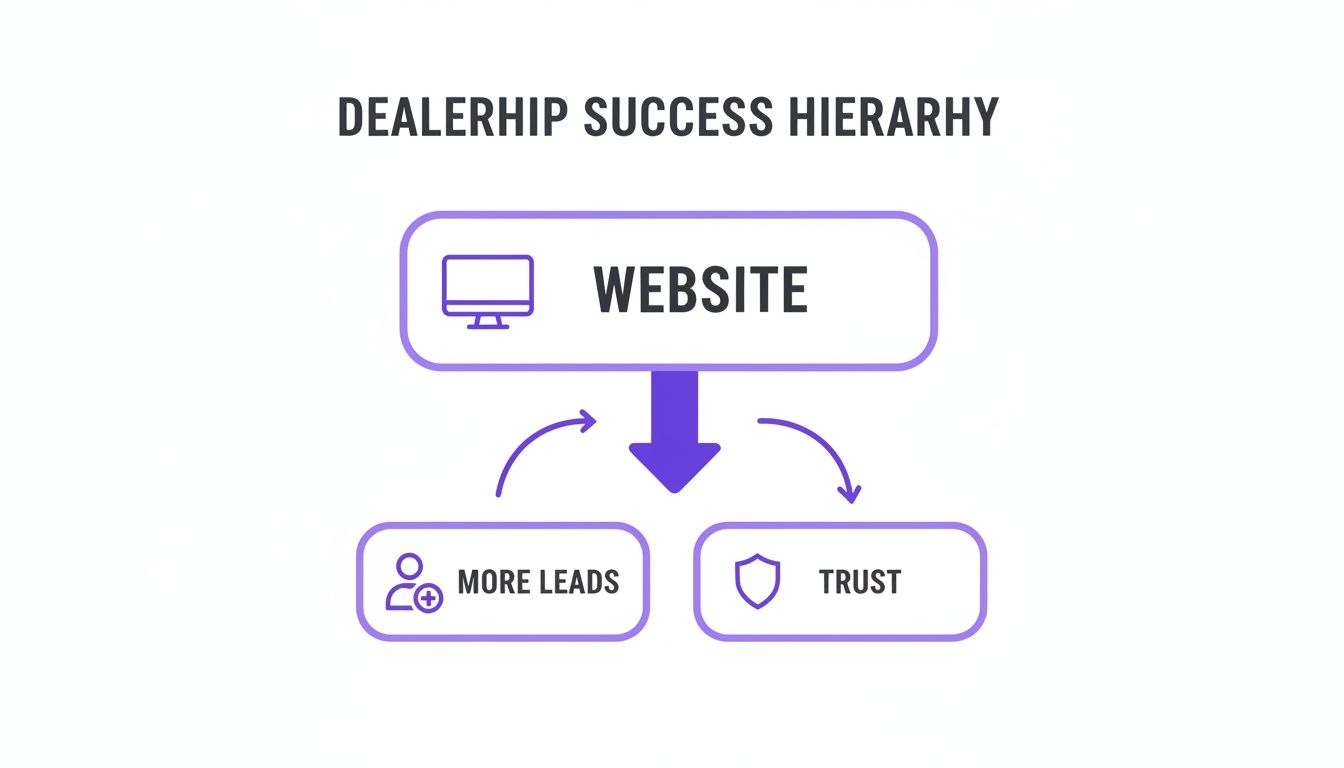
Your website isn't just a digital brochure. It’s the engine that powers customer trust and lead generation, and that all starts with a smart, simple structure.
Nailing Down Your Core Pages
Every great dealership website is built on a handful of essential pages. These are the pillars that answer your customers' most pressing questions and give them the confidence to head down to your lot. You don't need to overcomplicate it; a clean, logical structure is always the winner.
Your site absolutely must include these core pages:
- Homepage: This is your digital handshake. It needs to instantly show who you are, what you sell, and have a big, obvious inventory search bar front and center.
- Inventory Search Page (VRP): A clean, filterable gallery of every car on your lot. This is often the very next page a shopper visits.
- Financing Page: A simple, secure credit application is a must. This page is a lead-generation goldmine if you make it easy for people to get pre-approved.
- About Us: Tell your story! Car shoppers want to buy from real people they feel they can trust, and this page is where you build that connection.
- Contact Us: Make it impossible not to find you. Include your address, a clickable phone number, business hours, and an embedded Google Map.
This kind of clear hierarchy makes navigation a no-brainer for users and crawling a piece of cake for Google. It's a win-win. If you're exploring your options, our guide on choosing the right dealership website builder dives deeper into platforms that are built with this structure from the ground up.
Why Your Vehicle Detail Pages Are Your #1 Sales Tool
Every page on your site has a job, but the Vehicle Detail Page (VDP) is where the magic really happens. This is your digital sales pitch for one specific car, and it's hands-down the most critical page for turning a browser into a lead. When a shopper lands on a VDP, their interest is high—this is your chance to seal the deal.
Think of the VDP as your virtual showroom for a single car. It must provide every piece of information a serious buyer needs to make a decision. Your goal is to remove any reason for them to click away and keep looking.
A VDP with blurry photos or missing info is a dead end. It creates friction and doubt, sending potential buyers right into the arms of your competition. A great VDP, on the other hand, builds excitement and makes it incredibly easy for a customer to take the next step.
Anatomy of a High-Converting VDP
To turn those VDP views into solid leads, you need to include a few key elements. Each one is there to answer a question, build trust, or nudge the shopper toward taking action.
Here’s what every VDP absolutely must have:
- High-Resolution Photo Gallery: This is non-negotiable. Get 20-30 clear photos covering every single angle—interior, exterior, engine bay, and even close-ups of nice features or minor blemishes. Photos sell cars.
- Transparent Pricing: Put the price out there, clear as day. Including a call-to-action like "Request E-Price" is a great way to capture lead info in exchange for a special offer.
- Key Vehicle Specs: Automatically pull in the essentials like mileage, VIN, engine, transmission, and color. A good VIN decoder tool is your best friend here.
- A Real Vehicle Description: Don't just list factory specs. Write a short, engaging description that sells the car. Highlight its best features, its condition, and what makes it a great buy.
- Clear Calls-to-Action (CTAs): Don't make people hunt for what to do next. Big, bold buttons like "Schedule Test Drive," "Check Availability," and "Apply for Financing" should be impossible to miss.
- Vehicle History Report: Integrating a link to a CARFAX or AutoCheck report is one of the fastest ways to build credibility and show you have nothing to hide.
Perfecting your VDPs is the most direct path to increasing leads and selling more cars. By focusing your auto dealership web design efforts here, you’re optimizing the most profitable pages on your entire website.
Essential Features That Convert Visitors Into Leads
A great website for a used car dealership does a lot more than just look good—it actively works for you. The real difference between a digital brochure and a lead-generating machine comes down to the features you build into it. These are the tools that car buyers expect to see and use, making it dead simple for them to take the next step.
Think of your website as a dynamic extension of your lot, not just a static ad. The goal is to remove friction at every point, giving customers the info and confidence they need to reach out. This all starts with how you present your most important asset: your inventory.
Automated Inventory and Immersive Galleries
Manually updating your site every time a car sells or a new one hits the lot is a surefire way to create problems. It leads to outdated listings, frustrated shoppers, and a massive waste of your time. The answer is automated inventory management that syncs directly with your dealership management system (DMS) or whatever inventory feed you use. That way, when a vehicle is added or sold, your website updates on the spot.
Once that automation is in place, you need to create a viewing experience that pulls people in. High-quality photo and video galleries are non-negotiable. A shopper should be able to see every angle of a car, inside and out, without ever leaving their couch.
To build instant credibility, your vehicle detail pages (VDPs) absolutely need these elements:
- Integrated VIN Decoder: This tool is a lifesaver. It automatically populates all the vehicle's specs—engine, transmission, trim, and factory options. It guarantees accuracy and saves you hours of tedious data entry.
- 360° Vehicle Walkarounds: Interactive photo or video tours let shoppers virtually kick the tires. They can zoom in on features and get a real feel for the car's condition.
- Clear Vehicle History: A one-click link to a CARFAX or AutoCheck report is a massive trust signal. It shows you're transparent and have nothing to hide.
Frictionless Lead Capture Tools
So, a shopper is interested in a car. You now have a very small window to capture their info. If your forms are clunky, confusing, or ask for too much upfront, they’re gone. The whole point is to make saying "yes" as easy as possible.
Your website’s primary job is to start a conversation. Every form, button, and call-to-action should be designed to lower the barrier for a potential customer to raise their hand and show interest.
The best lead capture tools are simple and direct. Think about the key steps in the buying journey and create easy entry points for each one. This subtle shift in thinking can have a huge impact on your bottom line.
Believe it or not, top-performing dealership websites are now seeing 37% form submission rates by using smart digital retailing tools. That massive jump is directly tied to a site design that includes things like frictionless payment estimators and seamless inventory showcases. It's how you turn anonymous browsers into qualified leads. You can dig into more of these benchmark conversion rates at TradePending.com.
Making the Next Step Obvious
Your calls-to-action (CTAs) need to be impossible to miss. These are the buttons and links that guide a visitor from just looking to actually becoming a lead. Ditch the generic "Contact Us" links and use specific, action-oriented language instead.
Here are the essential lead capture forms every dealership site needs:
- Test Drive Request: A simple form asking for a name, email, phone, and maybe a preferred time. Keep it short.
- Finance Pre-Approval: A secure, multi-step form is key here. Breaking it into smaller chunks feels less intimidating and dramatically improves completion rates.
- "Check Availability" Inquiry: This is a low-commitment way for a customer to confirm a vehicle is still on the lot, giving your team an easy opening to start a dialogue.
- Trade-In Value Estimator: Offering an instant trade-in estimate in exchange for contact info is probably the single most effective lead magnet you can have.
By weaving these features into your auto dealership web design, you’re creating a powerful, self-sustaining system for generating real leads. You're not just showing cars; you're building a clear path that guides interested shoppers right to your sales team.
Driving Traffic with Smart Dealership SEO
You can have the most beautiful, feature-packed website in the world, but it won't sell a single car if local shoppers can't find it. That's where a smart SEO strategy comes into play. SEO for your dealership isn't about gaming the system; it's about making your site the most helpful and relevant answer for someone in your area searching for a used car.
Your entire auto dealership web design needs to be built with search engines in mind right from the get-go. This means creating a logical site structure, ensuring it loads lightning-fast, and filling it with valuable content that answers the questions your potential customers are actually asking.
Dominate Your Local Market
For an independent dealership, local SEO is your biggest advantage. You’re not trying to sell a truck to someone three states away; you need to connect with buyers right here in your city and the surrounding towns. The absolute foundation of this is your Google Business Profile (GBP).
Think about it: your GBP is often the very first impression a customer has of your dealership. It's what pops up in Google Maps and the "local pack" results when they search for "used car dealer near me."
To turn your profile into a local lead magnet, you have to get it right:
- Fill Out Everything: Don't skip a single section. Add your hours, service areas, and every attribute available. The more complete your profile is, the more Google trusts you.
- Use High-Quality Photos: Show off your lot, your best inventory, your friendly team, and your service bays. Real photos build real trust.
- Actively Manage Reviews: You have to respond to every single review—the good and the bad. It shows you're engaged and that you genuinely care about customer experience.
Your Google Business Profile is your digital storefront on the world's biggest search engine. Keeping it accurate, active, and full of positive reviews is non-negotiable for grabbing the attention of nearby, ready-to-buy car shoppers.
Optimizing Your Inventory for Search
Every single vehicle on your lot is a chance to rank on Google. Don't just list a car as a "2019 Ford F-150." You need to create a unique, keyword-rich title for every single Vehicle Detail Page (VDP).
A much better title looks like this: "Used 2019 Ford F-150 Lariat for Sale in [Your City, ST]". This targets both the specific truck and the local searcher.
This simple tweak transforms each VDP into a laser-focused landing page that can attract buyers looking for that exact make and model. The game has changed completely since Google went mobile-first. In fact, research shows that a high percentage of car buyers say their decisions are influenced by what they find in search results.
Tapping into Google Vehicle Listings
One of the best sources of free, high-intent traffic is Google Vehicle Listings. This feature puts cars for sale right in the search results, complete with photos, mileage, price, and your dealership's name. The best part? It costs you absolutely nothing to show up there.
To get your inventory included, your website needs to be built in a way that Google can easily read and understand your vehicle data. This is done with a technical element called schema markup.
A modern dealership website platform should handle this automatically. When you add a car to your inventory, the system should generate the right structured data behind the scenes. This allows Google to find your car and add it to the Vehicle Listings.
Getting this technical SEO piece right is crucial. It makes sure your inventory is seen where buyers are already looking, sending clicks directly to your VDPs without you paying for them. If you want to dive deeper, our guide on local SEO for car dealerships shows you how to pull all these tactics together.
Launching Your Site and Tracking What Really Matters
Getting your new dealership website live is a huge step, but don't pop the champagne just yet. The launch isn't the finish line; it’s the starting line. Before you tell the world, you need to do one last, thorough check to make sure everything works perfectly from day one.
Think of it as the final detail on a car before it hits the front line. You wouldn't want a customer's first impression to be a broken link or a form that goes nowhere. A few minutes of testing now can save you from major headaches and lost leads later.
Your Pre-Launch Checklist
Before you flip the switch, run through this quick but critical inspection. It's far better to catch a glitch yourself than to have a potential buyer discover it for you.
- Test every single form. Seriously, fill them all out yourself—test drive requests, finance applications, trade-in value forms. Did the lead email land in the right inbox? Did you get the confirmation auto-responder?
- Check it on your phone. Pull up the site on your smartphone and act like a customer. Can you easily browse inventory? Are the buttons big enough to tap? Do the pictures look sharp?
- Click everything. Go through your main menu, click every call-to-action button, and check the links in your footer. A dead link is a dead end for a customer and a bad signal to Google.
- Confirm your inventory sync. If you just added a fresh batch of cars, make sure they’re showing up online with all the right photos, prices, and details.
Once you’ve personally verified these items, you're ready to go live. Now, the real work begins: listening to what your website's data is telling you.
Measuring What Actually Moves the Needle
After launch, it's tempting to get obsessed with big-picture numbers like total website visitors. But those are often just vanity metrics. They don't tell you if your auto dealership web design is actually putting people in cars. You need to zero in on the Key Performance Indicators (KPIs) that directly tie to sales.
A thousand visitors who click away in five seconds are worthless. Ten visitors who dig into your VDPs and fill out a finance application are pure gold. Your focus has to shift from the quantity of traffic to the quality of engagement.
This is exactly why tools like Google Analytics 4 are non-negotiable. They let you see beyond the surface and understand exactly how real buyers are interacting with your inventory.
Key Performance Indicators for Your Dealership
Don't get lost in a sea of charts and graphs. Concentrate on the handful of metrics that truly reflect your website's health and its impact on your bottom line.
Here’s what you should be keeping an eye on every single week:
- Lead Form Submissions: This is your North Star. What percentage of your visitors are taking action by requesting a test drive, asking for more info, or applying for financing? If this number is going up, your site is doing its job.
- Time on Vehicle Detail Pages (VDPs): Are people spending a few seconds on a vehicle page and leaving, or are they sticking around for a minute or more, scrolling through all 20-30 photos and reading the specs? Longer time on page means higher interest.
- Bounce Rate on Key Pages: A high bounce rate (people leaving after viewing only one page) on your main inventory page could signal a problem. Maybe the search filters are confusing or the layout is clunky. This helps you spot friction points.
- Traffic Source Quality: Where are your best leads coming from? By tracking where your form submissions originate, you might discover that visitors from your Google Business Profile convert at a much higher rate than those from a social media ad.
By consistently tracking these performance-driven metrics, you can stop guessing and start making smart, data-backed decisions. You can test a different color for your "Apply Now" button or rewrite your vehicle descriptions and see, with hard data, what actually generates more leads. This cycle of measuring, tweaking, and improving is what will turn your new website into your dealership's most powerful salesperson.
Answering Your Top Questions About Dealership Websites
Let's cut to the chase. When you're thinking about a new website for your dealership, a lot of questions pop up—usually about money, time, and how much of a headache it's going to be. Below, I’ve answered the most common questions I hear from dealers, with straightforward advice to help you make a smart move.
Think of this as the condensed version of everything we've talked about, designed to give you clarity and confidence.
How Much Should a Good Dealership Website Actually Cost?
This is the big one, and honestly, the price can be all over the map. If you go the traditional marketing agency route for a fully custom build, you could be looking at anywhere from $10,000 to over $50,000. That gets you something completely unique, but it's a massive upfront cost and a long, drawn-out process.
On the flip side, you have the cheap, do-it-yourself website builders. It’s tempting, but it’s a classic case of getting what you pay for. They almost never have the critical tools you actually need to sell cars—things like automated inventory feeds, VIN decoding, or integration with Google Vehicle Listings. You end up with a digital business card, not a sales machine.
For the vast majority of independent dealers, the sweet spot is a specialized SaaS (Software as a Service) platform. These services bundle everything you need—professional design, car-specific features, hosting, and security—into a predictable monthly fee. You get a purpose-built tool without the custom-built price tag.
This model dodges the huge initial investment and saves you from the technical nightmares of managing a site yourself. You get a powerful website designed from the ground up to sell cars.
How Long Does It Realistically Take to Launch a New Site?
Time is money, and every month you're waiting on a website is a month of missed sales. A custom project with an agency can feel like it's dragging on forever, often taking three to six months from the first meeting to the day you finally go live. For a busy dealership, that kind of delay just isn't an option.
This is where a modern SaaS platform designed for the auto industry completely changes the game. Because the core technology, design templates, and inventory systems are already built and optimized for dealers, the setup is incredibly fast.
Instead of building a house from scratch, you’re just moving into a fully-furnished one and arranging the furniture. The platform is simply configured to your brand and hooked up to your inventory feed. This means you can have a professional, SEO-ready website up and running in a matter of hours or days, not months. That speed is a huge competitive advantage, letting you start generating leads right away.
Can I Actually Manage My Website Without Being a Tech Whiz?
You absolutely should be able to. The whole point of a modern dealership website solution is to let you manage your business, not force you to become a part-time web developer. You shouldn't need to know a line of code just to update a car's price or change your business hours.
A well-designed platform gives you a simple, intuitive dashboard to handle all the day-to-day stuff. This typically includes:
- Editing vehicle details and uploading photos
- Updating your hours and contact info
- Viewing and managing leads from your web forms
- Publishing a blog post or creating a special offers page
All the complicated technical work should happen in the background, completely invisible to you. Server maintenance, security patches, software updates—that's the platform's job. Your job is to focus on what you do best: buying and selling cars.
What's the Single Most Important Page on My Dealership's Website?
Your homepage gets the first look, but the Vehicle Detail Page (VDP) is where the magic really happens. This is your digital showroom. It's the moment a casual browser becomes a serious, high-intent buyer. When a customer lands on a VDP, they're not just kicking tires; they're actively considering that specific vehicle.
Your VDP is where a sale is won or lost online. It needs to give a buyer every single piece of information they need to feel confident and take the next step, answering their questions before they even think to ask them.
If you focus on optimizing one thing, make it your VDPs. A great one is so much more than a list of specs. It’s a compelling sales pitch built with high-quality photos from every angle, transparent pricing, detailed vehicle info, a clear history report, and multiple, obvious calls-to-action. Big, bold buttons like "Schedule Test Drive" or "Apply for Financing" are essential for guiding the customer forward and turning their interest into a real lead for your team.
Ready to launch a website that works as hard as you do? AutoFire delivers a fast, mobile-first website platform built specifically for independent dealerships. Get online in minutes with automated inventory, built-in SEO, and lead capture tools that turn visitors into buyers.