

A car dealer website builder is a platform built specifically for one job: creating websites that sell cars. Unlike generic tools, it comes packed with features essential for automotive sales, like automated inventory management and VIN decoding. It’s designed from the ground up to help dealerships get their vehicles seen, capture buyer leads, and climb the ranks in local search results.
Why Generic Website Builders Fall Short for Dealerships
Trying to run a car dealership's website on a generic platform like Wix or Squarespace is like trying to build a high-performance engine with a standard home toolkit. Sure, you have a hammer and a wrench, but you're missing the specialized machinery needed to handle the complex moving parts of automotive sales.
For a dealership, this approach leads to a frustrating cycle of manual work, missed opportunities, and a clunky experience for potential buyers. Staff waste hours manually updating inventory, a tedious task ripe for errors. You might end up advertising a car you sold yesterday or listing the wrong features. Worse yet, leads from various forms get scattered across inboxes instead of funneling into a system built to manage them. It’s a recipe for chaos.
The Digital Showroom Dilemma
Let’s face it: the car buying journey no longer starts on the lot. It starts on a screen. Modern car shoppers overwhelmingly turn to online resources before they ever set foot in a dealership.
These buyers aren't just browsing; they're deep in research, often visiting multiple websites and spending a significant amount of that time on their phones. A seamless digital experience isn't a "nice-to-have" anymore—it's absolutely essential. You can dig deeper into these automotive digital marketing trends and see how they're reshaping the industry.
This is where a purpose-built car dealer website builder stops being an upgrade and becomes a necessity. It’s not just a different tool; it’s an entirely different machine designed for one thing: selling cars online.
Think of it as your dealership's digital command center. It’s an all-in-one system engineered to sync inventory automatically, capture high-quality leads with car-specific forms, and dominate the local search results where your customers are actually looking.
Built for a Specific Purpose
The core issue is that generic builders weren't designed to handle the unique demands of the car business. It's not in their DNA. Trying to force them to work often exposes critical gaps.
For example, they don't have:
- Automated Inventory Sync: There are no built-in connections to your Dealer Management System (DMS) for real-time stock updates.
- VIN Decoding: The ability to instantly pull vehicle specs from a VIN is a feature you simply won't find out of the box.
- Automotive SEO: They lack the specialized tools needed to get your inventory showing up in Google Vehicle Listings, which is crucial for attracting ready-to-buy shoppers.
To really illustrate the difference, let’s compare a generic builder to a platform designed for dealerships.
Generic Builder vs. Specialized Automotive Platform
| Key Function | Generic Website Builder (e.g., Wix) | Car Dealer Website Builder |
|---|---|---|
| Inventory Management | Manual data entry for each car. Prone to errors and delays. | Automatically syncs with your DMS. Real-time updates. |
| VIN Decoding | Not available. All vehicle details must be entered by hand. | Instant VIN lookup populates specs, features, and history. |
| Lead Capture Forms | Basic contact forms. Not tailored to auto sales inquiries. | Custom forms for test drives, trade-ins, and financing apps. |
| SEO for Cars | General SEO tools. No specific features for vehicle listings. | Optimized for Google Vehicle Listings and local auto searches. |
| Integrations | Limited to general apps (e.g., email, calendars). | Connects to DMS, CRM, and auto marketing platforms. |
| Mobile Experience | Mobile-responsive, but not designed for vehicle browsing. | Mobile-first design for easy inventory search and viewing. |
The table makes it clear: while a generic builder can put you online, a specialized platform is what gives you the power to actually compete.
Ultimately, a solution built for dealers is the key to turning online browsers into showroom visitors. It provides the powerful, integrated framework you need to build a stronger, more efficient sales pipeline from the ground up.
So, What Exactly Is a Car Dealer Website Builder?
Let’s get straight to it. A car dealer website builder isn't just another tool like Squarespace or Wix with a car-themed template slapped on top. It’s a complete, purpose-built platform designed specifically for the business of selling cars online.
Think of it like this: a generic website builder gives you an empty garage. You have the space, but you still have to source all the tools, build the car lifts, and figure out how to run the diagnostics yourself. A specialized dealer platform, on the other hand, is a fully-equipped, turn-key service bay. Everything you need is already there, integrated, and ready to go from day one.
The Engine Room: Automated Inventory Management
The absolute heart of any dealer website builder is its inventory management system. This is the engine that drives your entire online operation. It’s not just a gallery to upload photos; it’s a living, breathing system that syncs directly with your dealership's reality.
It hooks into your Dealer Management System (DMS), creating a seamless connection between your physical lot and your digital showroom. When a car sells, it automatically disappears from the website. No more awkward phone calls explaining that the "2019 Civic they just saw online is already gone."
A key part of this engine is the VIN decoder. You just plug in the vehicle's VIN, and the system instantly pulls in all the critical details—trim level, engine size, factory options, the works. This saves you countless hours of mind-numbing data entry and, more importantly, ensures your listings are accurate. Accuracy builds trust, and trust sells cars.
The flowchart below shows what happens when this engine sputters. Manual updates, a clunky mobile site, and confusing navigation don't just create headaches for you; they actively drive potential buyers away.
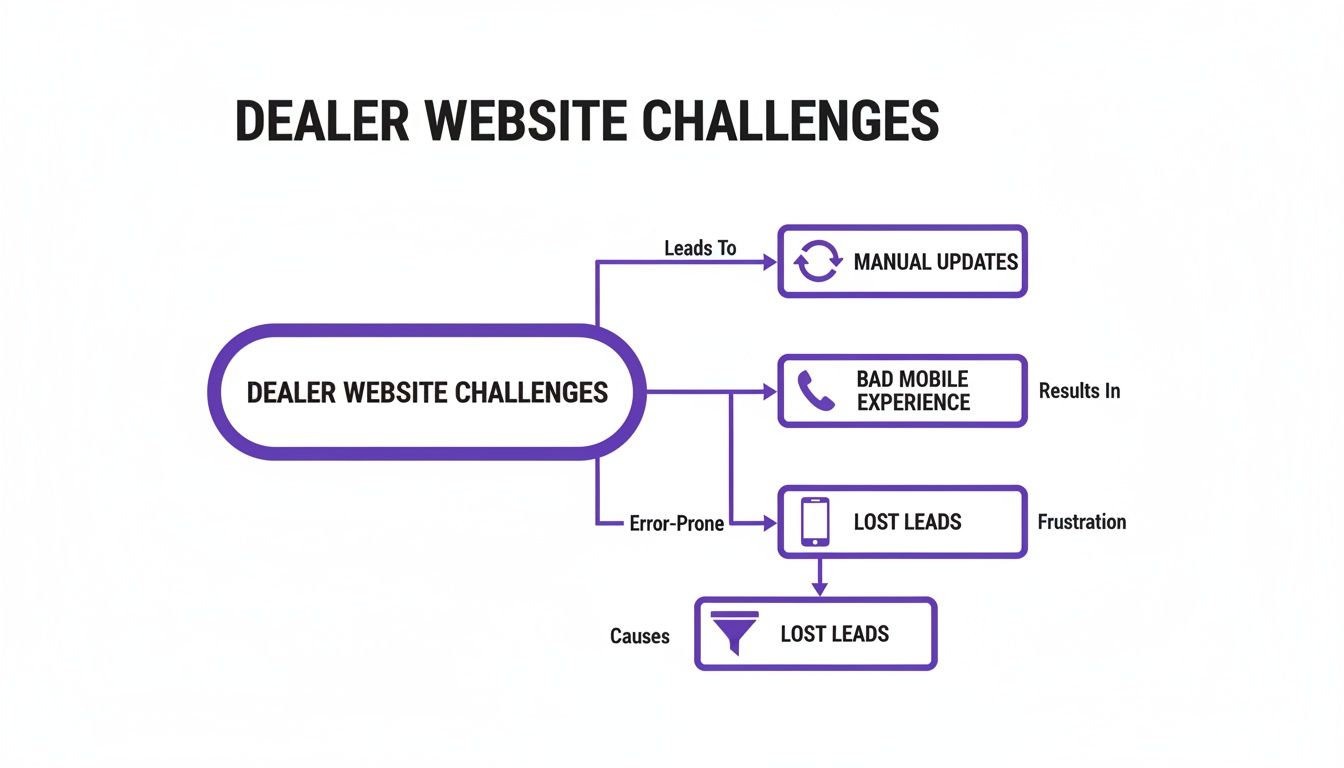
As you can see, a weak foundation leads to a domino effect of problems that ultimately costs you real leads and sales.
The Framework: Built for Mobile Shoppers and Sales
Next, let's talk about the chassis—the underlying structure of the website itself. For any car dealership today, this has to be mobile-first. Period. The vast majority of your customers start their car search on their phone, often while standing on another dealer's lot. If your site is a pinch-and-zoom nightmare on a small screen, you’ve already lost them.
A proper dealer platform is designed from the ground up to give mobile users a smooth, intuitive experience. Browsing inventory, filtering by make or price, and viewing vehicle details should feel effortless. The entire layout is engineered to guide visitors from a casual search toward taking the next step, whether that's getting a trade-in value or scheduling a time to come in.
A purpose-built platform isn't just a passive online brochure. It's an active sales assistant. Every button, every form, and every photo gallery is strategically placed to do one thing: turn a curious browser into a qualified lead in your CRM.
The Showroom Floor: Tools That Engage and Convert
Finally, you have the customer-facing features—the digital equivalent of your showroom floor. These are the interactive tools that let shoppers kick the virtual tires and get genuinely engaged with your inventory.
These aren't just fancy add-ons; they are essential for modern car sales:
- High-Resolution Photo Galleries: Crystal-clear images from every angle are non-negotiable. Shoppers want to see it all before they even think about visiting.
- Walk-Around Video: A simple video tour gives a much better sense of a car's condition and presence than static photos ever could.
- Payment & Financing Calculators: Empowering buyers to crunch the numbers and see what they can afford makes them far more likely to take the next step.
- Integrated Lead Forms: Smart, simple forms for everything from test drive requests to credit applications, placed right where the customer needs them.
When the engine, framework, and showroom all work together seamlessly, your website transforms from a simple online listing into a powerful, 24/7 sales machine. Your inventory is always up-to-date, customers have a great experience on any device, and the site actively works to bring them through your dealership's door.
Features That Turn Online Traffic Into Test Drives
A specialized car dealer website builder isn't just a digital business card; it's an active sales machine humming in the background 24/7. The right features don't just look good—they create a straight line from a casual online search to a scheduled test drive. These are the non-negotiable tools that transform your website from a passive online brochure into an engine for serious growth.
Automated Inventory and VIN Decoding
First things first: imagine never having to manually update your online inventory again. This is the single biggest time-saver a dedicated platform can offer. Automated inventory synchronization plugs directly into your Dealer Management System (DMS), making sure your website always shows what’s actually on your lot.
When a car sells, it's gone from the site automatically. When you get a new vehicle, it pops up online within minutes. This simple feature is huge for customer trust—no more angry calls about a car you sold yesterday.
Tied directly to this is VIN decoding. Instead of painstakingly typing out every single feature and spec, you just enter the VIN. The system instantly fills in the listing with the correct trim level, engine type, and factory options. This not only saves you hours of tedious work but also prevents costly mistakes in your listings.
A Mobile-First Design for Today's Buyers
Let’s be honest, modern car shoppers aren’t waiting to get home to their desktops. They’re browsing for their next car on their phone during a lunch break, on the couch, or even while standing on a competitor's lot. If your website is a clunky, slow-loading mess on a small screen, you've already lost them.
This is why a mobile-first design is non-negotiable. It means your website was built for a phone from the ground up, not just a shrunken-down version of your desktop site. A great mobile experience boils down to a few key things:
- Large, Tappable Buttons: No fat-fingering tiny links. Controls for filtering cars and viewing details should be easy to use.
- Blazing-Fast Load Times: People are impatient. Pages and photos need to load instantly to keep them engaged.
- Simple Navigation: A clear, intuitive menu helps shoppers find exactly what they're looking for without getting frustrated.
- Click-to-Call Functionality: A potential buyer should be able to call you with a single tap.
Focusing on the mobile journey is just smart business. As the automotive retail landscape evolves, buyers expect everything from payment calculators to vehicle history reports at their fingertips, and a solid website builder is what makes that possible.
A website that works flawlessly on a phone isn't just a nice-to-have; it's a powerful lead-gen tool that meets customers where they are. It respects their time and gives them the confidence to take the next step.
Automotive SEO and Google Vehicle Ads Integration
Having a website is one thing, but getting found is another. Generic website builders offer basic SEO tools, but they’re completely outgunned in the competitive car sales market. A specialized platform comes with automotive SEO baked right in, specifically designed to help your inventory show up for high-intent local searches like "used Honda CR-V near me."
A big part of this is handling the technical stuff, like schema markup for vehicles, which helps Google understand your listings. Even better, a good builder integrates directly with Google Vehicle Ads. This lets your cars appear at the very top of Google's search results with photos, pricing, and mileage—placing your inventory right in front of motivated buyers at the exact moment they're looking. It’s one of the best ways to get free, highly qualified traffic to your site.
Advanced Lead Forms and CRM Integration
Okay, so a shopper is interested. Now what? You need a smooth, easy way to capture their info. A proper car dealer website builder knows a generic "contact us" form won't cut it. You need specialized forms that match exactly what the buyer wants to do next.
These are the essential lead capture tools you should look for:
- Test Drive Request Forms: Simple forms that let a user quickly book an appointment to see a specific car.
- Trade-In Valuation Forms: Allows a potential customer to submit details on their current vehicle to get a trade-in estimate, starting a crucial conversation.
- Financing Applications: Secure forms that capture the info needed to get the credit approval process started.
And here’s the most important part: those leads shouldn't just die in a cluttered email inbox. They need to flow directly into your Customer Relationship Management (CRM) system. This CRM integration ensures every single lead is tracked, assigned to the right salesperson, and followed up on quickly, so potential sales don't fall through the cracks. Exploring the full range of available features shows just how deeply these tools can tie into your existing sales process.
Your Framework for Evaluating Website Builder Providers
Picking the right partner for your dealership’s website is a huge decision, maybe just as important as the technology itself. The platform gives you the tools, sure, but the company behind it is what really dictates your long-term success through support, updates, and genuine guidance.
To make the right call, you need a smart way to cut through the sales pitches and evaluate providers on what actually matters to your business. This simple framework will help you ask the right questions and compare your options head-to-head. By zeroing in on four critical areas, you'll get a crystal-clear picture of who will be a real growth partner for your dealership.
Inventory and DMS Integration
Let's be honest, your inventory is the heart and soul of your dealership. That means a seamless connection to your Dealer Management System (DMS) is absolutely non-negotiable. A clunky or unreliable integration creates a domino effect of problems: inaccurate listings, hours of wasted time, and seriously frustrated customers.
So, when you’re looking at a car dealer website builder, start by digging into how their inventory system really works.
Don't just ask, "Do you integrate with my DMS?" Ask how they do it. Is it a real-time, two-way sync, or just a lazy data dump that happens once a night? A delay of even a few hours could mean you’re still advertising a car you sold that morning.
Here are the essential questions you need answered:
- Does your platform support my specific DMS? You need a firm "yes" for your exact system, not a vague "we support most of them."
- How often does the inventory sync run? You should be looking for real-time or, at the very least, updates every few minutes to keep everything accurate.
- Is the VIN decoder built-in, and how accurate is it? Make them prove that it automatically pulls the correct trim levels and factory options. This saves you a massive amount of manual work.
Marketing and SEO Tools
A beautiful website that nobody can find is just a very expensive digital brochure. Your website platform has to come loaded with marketing and search engine optimization (SEO) tools built specifically for dealers. Generic SEO plugins from WordPress just won’t cut it when you’re fighting for local car buyers.
The absolute must-have feature here is built-in support for Google Vehicle Listings. This is what gets your inventory to pop up directly in Google's search results when someone is looking for a specific make and model near you. It’s one of the single most powerful ways to get in front of shoppers who are ready to buy right now.
A provider that treats automotive SEO as an afterthought is setting you up for failure. The platform should be engineered from the ground up to make your vehicles as visible as possible on search engines where your customers are actively looking.
Lead Management and Customization
Once you get shoppers to your site, its primary job is to turn those clicks into leads. The lead management tools a provider offers will have a direct impact on your sales pipeline. Basic "contact us" forms aren't enough—you need tools designed for the car buying journey.
Check out how customizable their lead forms are. Can you easily create forms for test drive requests, trade-in appraisals, or financing pre-approvals? And just as important, where do those leads end up? The system needs to plug right into your dealership’s CRM so every single lead is tracked and followed up on immediately. A good provider can show you exactly how this works—and you can see it for yourself by requesting a personalized demo to understand the lead flow.
Support and Onboarding
Finally, you have to think about the people behind the product. When something inevitably goes wrong or you need a hand making a change, what’s their support like? A fantastic product with terrible support will become a major headache, fast.
Ask about their onboarding process. Will they hold your hand through migrating all your data and getting your team comfortable with the new system? Get a clear understanding of their support channels (phone, email, chat) and their typical response times. A company that invests in quality support is a partner that's invested in your success, making sure you have the help you need, right when you need it.
Provider Comparison Scorecard
Choosing a partner is a big commitment. Use this checklist to score potential website builder providers across the most important features and services for your dealership. It's a simple way to keep your evaluation objective and focused on what truly matters for your bottom line.
| Evaluation Criteria | Provider A Score (1-5) | Provider B Score (1-5) | Notes |
|---|---|---|---|
| DMS Integration Quality | Real-time sync? Accurate data? | ||
| VIN Decoder Accuracy | Pulls correct trims/options? | ||
| Google Vehicle Listings | Is it built-in and automated? | ||
| Automotive SEO Tools | VDP optimization, local SEO, etc. | ||
| Lead Form Customization | Can you build specific forms easily? | ||
| CRM Integration | Does it connect to your system? | ||
| Onboarding Process | Do they handle migration? Training? | ||
| Support Quality & Speed | Phone support? Fast response? | ||
| Mobile-First Design | How does it look/work on a phone? | ||
| Overall Value for Price | Is the cost justified by features? |
After scoring each potential partner, the right choice should become much clearer. The provider with the highest score in the areas most critical to your dealership is likely the best long-term fit.
How to Navigate Pricing and Avoid Hidden Fees
A great website platform shouldn't come with financial surprises. Investing in a car dealer website builder is a smart move, but you need to get a firm handle on the costs to budget properly and avoid getting hit with unexpected bills later on. The first step is understanding how these services are typically priced.
The online car market is on fire right now. Recent data from IBISWorld shows the online car dealer industry in the U.S. has grown to a significant market size and has been expanding steadily for the past five years. This incredible growth proves that a powerful, cost-effective online presence isn't just nice to have—it's essential for any dealership that wants to compete. You can find more data on the online car dealer market on ibisworld.com.
Decoding Common Pricing Structures
As you start looking at different providers, you'll run into a few common pricing models. Each one is structured a bit differently, so knowing what you're looking at will help you compare your options apples-to-apples.
Most modern platforms run on a monthly subscription model. This is a predictable, recurring fee that usually covers hosting, security updates, and basic customer support. It makes budgeting simple.
You might also see a one-time setup fee. This usually covers the initial legwork of building your site, pulling in inventory from your old system, or setting up your DMS integration. It’s less common with today's SaaS platforms, but it’s always something to ask about.
Finally, many plans are tiered based on your inventory size. A small, independent lot with 20 cars on the ground will pay less than a larger dealership managing over 100 vehicles. This approach makes sense—you only pay for what you actually use.
Exposing the Hidden Costs
Be careful, because the price on the sales page isn't always the final price. Hidden fees can quickly inflate what you thought was a good deal, turning it into a real budget-buster.
A transparent provider will be upfront about all potential costs. If you have to dig for information on pricing for essential features, consider it a red flag. True partners want you to succeed, not to surprise you with invoices.
Keep an eye out for these common extra charges:
- Third-Party Integration Fees: Will they charge you extra to connect to your specific DMS or CRM? This is one of the first questions you should ask.
- Advanced Feature Add-Ons: Sometimes, critical tools like a VIN decoder or advanced SEO features are locked behind a pricier plan or sold separately.
- Premium Support Charges: Basic email support might be included, but what if you need to talk to someone on the phone? Or want a dedicated account manager? Find out what level of help your plan includes.
- Data Migration Costs: Moving your current inventory and customer data over to the new platform might come with its own service charge.
The best way to protect yourself is to ask the right questions before you commit. Before signing anything, get in touch with the provider and get the total cost in writing, including any add-ons you might need down the road. A simple conversation today can save you from a major headache tomorrow.
A Smooth Launch Plan for Your New Dealership Website

Switching to a new website can feel like trying to swap out an engine while the car is still running. But it doesn't have to be that chaotic. With a solid plan, the entire process becomes much more manageable, moving from a source of stress to a straightforward project.
A smart launch is all about breaking it down into clear, logical steps. Think of it in three key stages: what you do before you flip the switch, what happens on launch day, and how you fine-tune everything afterward. This approach helps you sidestep common headaches like your site going down, your Google rankings tanking, or your inventory data getting scrambled.
The Pre-Launch Preparation Phase
This is where all the important groundwork happens. Before anyone sees your new site, your website provider should be deep in the details, getting everything just right. This stage is all about gathering your assets, moving your data, and locking in the final look of your new digital showroom.
Your main job here is to provide the raw materials:
- Content and Asset Gathering: You'll need to hand over high-quality logos, photos of your team, the "About Us" story that makes your dealership unique, and any other brand content.
- Design Finalization: This is your chance to review and approve the site’s layout, colors, and overall vibe. Does it feel like your dealership? Now's the time to say so.
- Data Migration Review: You'll work with your provider to double-check that all your existing inventory specs, customer info, and other essential data are mapped correctly for a clean transfer.
Think of this phase as the final walk-around before a customer takes delivery. It’s your chance to check every detail, confirm all the features are in place, and give the final sign-off before the keys are handed over.
The Go-Live Process
Once all the prep work is done, it's time for the technical launch. This part is almost entirely handled by your car dealer website builder partner—they do the heavy lifting behind the scenes. The goal is a seamless switchover with zero disruption to your business.
Here’s what’s typically happening on their end:
- Final Technical Setup: They'll be configuring the server, installing security certificates, and making sure the site is rock-solid and ready for visitors.
- DMS Integration Activation: The live connection to your Dealer Management System gets turned on, ensuring your inventory is syncing perfectly in real time.
- Quality Assurance Checks: One last, thorough sweep of the live site is done to catch any broken links, weird formatting, or bugs on mobile devices.
Post-Launch Optimization and Success
Congratulations, your new website is live! But the job isn't quite finished. The first few weeks are critical for making sure the site is performing as it should and that your team is comfortable using it. Now is the time to watch your analytics, get your people trained up, and hit the gas on your marketing.
Your focus should shift to these key activities:
- Staff Training: Make sure your sales team and office staff know their way around the new system. Can they easily manage leads? Can they update a vehicle description?
- Performance Monitoring: Keep a close eye on your website analytics. You’ll want to track traffic, how many lead forms are being filled out, and whether people are sticking around or bouncing right off the site.
- Marketing Campaign Activation: It's time to drive traffic. Launch those new marketing campaigns you've been planning and start taking advantage of your site's new SEO power and better lead-gen tools.
Got Questions? Here Are the Answers
Moving to a new website platform is a big step, and it's smart to have questions. To give you some extra clarity, we've pulled together the most common things we hear from dealers who are thinking about a car dealer website builder. Getting good, honest answers is the only way to feel confident you're making the right move for your lot.
Let's tackle these questions head-on so you know exactly what to expect.
How Long Does It Take to Get My New Site Online?
This is usually the first thing dealers ask. The timeline really depends on the provider you choose and how complex your setup is, but a modern platform should have you up and running quickly. We’re talking weeks, not months.
The launch process generally breaks down into a few simple stages:
- Discovery and Design: Nailing down the look and feel you want.
- Data Integration: Hooking up your DMS so your inventory syncs perfectly.
- Adding Your Content: This is where you add your dealership’s story, staff photos, and other custom pages.
- Final Look-Over and Launch: One last check before you hit the big green button.
Can I Keep My Current Domain Name?
Of course. In fact, you absolutely should. Your domain name is a huge part of your brand and holds all the SEO value you've worked hard to build. Starting over is the last thing you want to do.
The switch is straightforward. When your new website is ready, you'll just need to update your domain's settings to point to the new hosting servers. Any good website partner will give you clear instructions or even handle this part for you to make sure everything goes off without a hitch.
A professional car dealer website builder will never ask you to change your domain. Their job is to make the switch seamless, protecting the online reputation and search engine trust you've already earned.
What Kind of Support Can I Expect?
Support levels can be all over the map, so this is a big one to dig into. Most providers offer different tiers of support to fit what your dealership needs and can afford.
Typically, a standard plan will get you email or ticket-based help for any technical hiccups. If you go with a more premium plan, you might get perks like direct phone support, a dedicated person to call, or faster help when something urgent comes up. Make sure you ask exactly what's included so there are no surprises when you need a hand.
How Does a New Website Actually Help Me Sell More Cars?
At the end of the day, this is what it’s all about. A great website builder helps you sell more cars by smoothing out all the bumps in the online car-shopping process. It’s not just about having a prettier site; it's about having one that works smarter.
A platform built for dealers connects all its features to real-world results:
- It gets you better leads. Optimized forms for test drives, financing, and trade-ins capture buyers who are serious, not just kicking tires.
- It makes you more visible. With built-in automotive SEO and integrations like Google Vehicle Ads, your cars show up right when local shoppers are searching for them.
- It converts mobile shoppers. So many customers browse on their phones. A fast, easy-to-use mobile experience keeps them on your site and turns that interest into an appointment.
Ready to see how a modern, purpose-built website can drive more leads and simplify your operations? With AutoFire, you can launch a professional, mobile-first website in minutes and start showcasing your inventory where buyers are searching. Get started for free today.